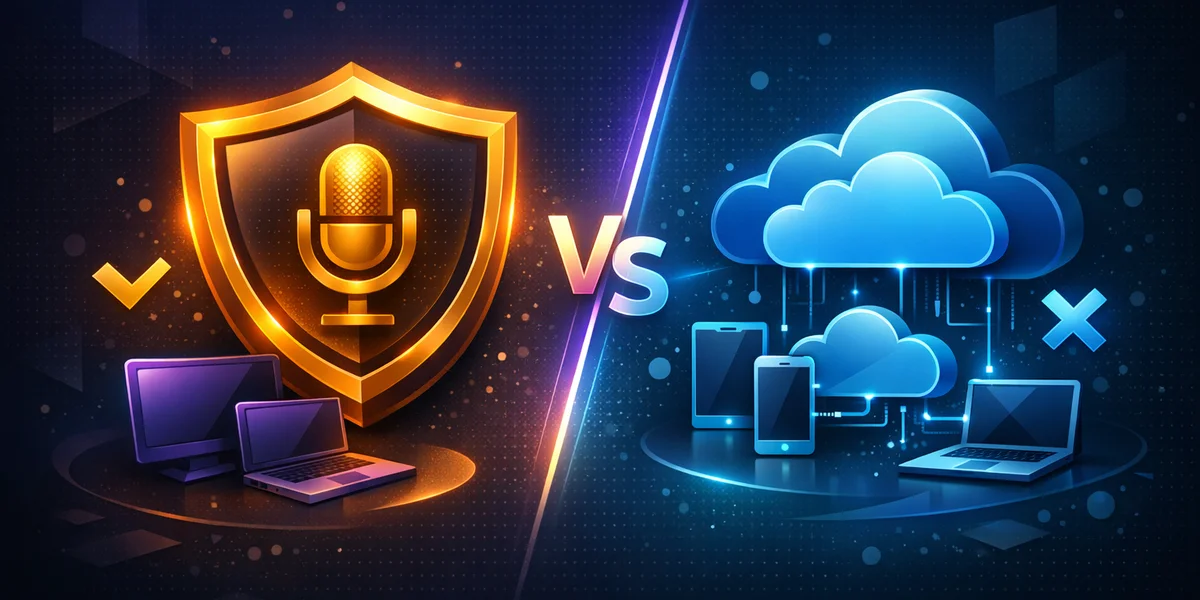
The best dictation software in 2026 is Weesper Neon Flow for professionals who need offline privacy, Dragon Professional for Windows-only specialist vocabularies, and Otter.ai for cloud-based meeting transcription. In this voice dictation comparison 2026 roundup, we benchmark 8 tools across accuracy, privacy, pricing, platform support, and language coverage so you can pick the best voice typing app for your workflow.
The speech-to-text market is crowded, and every tool in it claims to be the most accurate. That means more choice — and more confusion. We cut through the noise with hands-on data.
Which is the best dictation software 2026 comparison winner?
Weesper Neon Flow earns the top spot for most professionals thanks to its unique combination of offline processing, cross-platform support, and flat-rate pricing. Below is the full head-to-head comparison.
| Tool | Accuracy | Privacy | Platforms | Languages | Pricing | Best For |
|---|---|---|---|---|---|---|
| Weesper Neon Flow | 95–99% | Offline (on-device) | macOS, Windows | 99 | €5/month | Privacy-focused professionals |
| Dragon Professional | 95–99% | Local processing | Windows only | 9 | Not published (one-time) | Medical/legal specialists |
| Otter.ai | 90–95% | Cloud | Web, iOS, Android | 3 | Free–$16.99/user/month | Meeting transcription |
| Whisper (OpenAI) | 92–97% | Self-hosted | CLI / API | 99 | Free (open-source) | Developers, tinkerers |
| Descript | 90–95% | Cloud | macOS, Windows | 23 | $16–24/person/month | Video/podcast editors |
| Apple Dictation | 88–93% | On-device | macOS, iOS | 60+ | Free | Casual Mac users |
| Windows Speech Rec. | 80–88% | On-device | Windows | 8 | Free | Basic Windows dictation |
| Google Docs Voice Typing | 90–95% | Cloud (Google) | Browser | 125+ | Free | Quick browser drafts |
Key takeaway: Only Weesper and Dragon offer professional-grade accuracy with fully local processing. Weesper adds macOS support, 99 languages, and a subscription 60x cheaper than Dragon’s one-time licence. For users curious about newer agentic cloud entrants that combine dictation with voice-triggered actions, our VoiceOS review compares the trade-offs.
How does accuracy compare across dictation tools in 2026?
Modern speech-to-text engines achieve word error rates (WER) between 3% and 5% in clean conditions — approaching the human benchmark of roughly 2.5% WER. Real-world accuracy, however, depends on microphone quality, background noise, accents, and vocabulary complexity.
Stanford’s landmark study found that speech input is 3x faster than typing on a smartphone keyboard, with 20% fewer errors on English text. That speed advantage holds only when accuracy is high enough to avoid constant corrections.
Here is how the tools stack up under real-world conditions:
- Weesper Neon Flow — Uses Whisper.cpp locally with Metal (macOS) and CUDA (Windows) acceleration. Handles accents well. Custom vocabulary support lets you add technical terms, medical jargon, or legal phrasing.
- Dragon Professional — Decades of domain-specific training data give it an edge in medical and legal contexts. Accuracy improves over time as it learns your voice.
- Whisper (OpenAI) — Excellent baseline accuracy but requires technical setup. No real-time dictation out of the box; designed for file transcription.
- Otter.ai — Strong in meetings with speaker identification. Struggles with heavy accents and overlapping speakers.
- Apple Dictation — Decent for short bursts. No custom vocabulary. Performance degrades noticeably after 60 seconds.
If you specifically want to replace Apple’s built-in dictation, our 8 best Apple Dictation alternatives for Mac compares the credible options head-to-head. If accuracy is your top priority for specialised terminology, read our guide on building a custom vocabulary for technical terms.
Why does offline vs cloud processing matter?
Offline dictation keeps every word on your device — no audio is uploaded, no text is stored on a third-party server, and no internet connection is needed. This matters for three reasons: privacy, reliability, and cost.
Privacy risk is real. A 2025 PoPETs study documented how voice assistants profile users through acoustic characteristics, ambient sounds, and speech patterns — even when the user believes recording is off. Cloud dictation tools operate similarly: your audio travels to remote servers for processing.
Reliability is non-negotiable. Cloud tools fail when your connection drops. On an aeroplane, in a rural courthouse, or during an internet outage, only offline tools keep working.
Cost can spiral. Per-minute cloud pricing punishes heavy users. A professional dictating 2 hours daily could pay €50–100 per month on consumption-based plans. Flat-rate offline tools eliminate that uncertainty.
| Factor | Offline (Weesper, Dragon) | Cloud (Otter, Google, Descript) |
|---|---|---|
| Data leaves device | Never | Always |
| Works without internet | Yes | No |
| GDPR/HIPAA suitable | Yes | Depends on provider DPA |
| Per-minute cost risk | None (flat fee) | Possible |
| Setup complexity | Install once | Account + browser/app |
For a deeper look at why offline processing is critical for regulated industries, see our article on offline voice dictation and privacy. When choosing between Weesper and newer cloud-based alternatives like Willow, our Weesper vs Willow comparison analyses offline privacy versus cloud speed in detail. Our Weesper vs Typeless comparison runs the same analysis against a cloud tool that claims zero data retention.
Want to test offline dictation right now? Try Weesper Neon Flow free for 15 days — no account, no cloud uploads, no credit card.
What does each tool cost — and is it worth it?
Pricing models vary wildly across dictation software. Some charge per minute, others per month, and a few demand a hefty one-time licence fee. Here is the breakdown.
| Tool | Model | Monthly cost (typical) | Annual cost | Free tier |
|---|---|---|---|---|
| Weesper Neon Flow | Subscription | €5 | €45 | 15-day trial |
| Dragon Professional | One-time licence | N/A | Not published | No |
| Otter.ai | Freemium | $0–20 | $0–240 | 300 min/month |
| Whisper | Open-source | $0 (self-host) | $0 | Unlimited |
| Descript | Subscription | $16–24 | $192–288 | 1 hr/month |
| Apple Dictation | Built-in | $0 | $0 | Unlimited |
| Windows Speech Rec. | Built-in | $0 | $0 | Unlimited |
| Google Docs Voice Typing | Free (Google) | $0 | $0 | Unlimited |
Value analysis: Weesper delivers professional accuracy and offline privacy at €45 per year — less than a single Dragon licence and far less than Otter Pro’s annual cost. Free tools save money upfront but cost time: lower accuracy means more manual corrections.
Newer entrants push the subscription model further still: Monologue, the Apple-only dictation app published by Every, charges $15/month with no one-time option — see our Monologue review for what that buys you. On Windows, Whisperstream takes the opposite pricing bet — a $29 one-time licence built on NVIDIA Parakeet; our Whisperstream review checks what stays local and what can reach the cloud.
For a detailed pricing breakdown with per-hour cost calculations, check our voice dictation pricing comparison guide.
How do these tools handle multiple languages?
Multilingual support is increasingly important as remote teams span continents and professionals work across language barriers. The gap between tools is enormous.
- Weesper Neon Flow — 99 languages with the same offline engine. Switch languages mid-session without restarting. Ideal for multilingual professionals.
- Whisper — 99 languages (same underlying model as Weesper). Requires technical setup per language.
- Google Docs Voice Typing — 125+ language codes, but accuracy drops sharply outside the top 10 languages.
- Apple Dictation — 60+ languages, but quality varies significantly. Limited to on-device models for non-English languages.
- Dragon Professional — Only 9 languages, and each requires a separate purchase. No macOS support.
- Otter.ai — English, French, and Spanish only. Not viable for multilingual workflows.
If working across languages is central to your role, see our guide on multilingual voice dictation across multiple languages. For mobile specifically, our best voice dictation apps for iPhone and Android in 2026 benchmarks every major iOS and Android dictation option side by side.
Who should choose which tool? Recommendations by use case
Every dictation tool has a sweet spot. The right choice depends on what you actually do with it.
Choose Weesper Neon Flow if you are a professional who values privacy, works across platforms (Mac and Windows), needs unlimited dictation, and handles confidential material — lawyers, consultants, medical professionals, writers, journalists. It is the best voice typing app for professionals who cannot afford data leaks.
Choose Dragon Professional if you are a Windows-only user in healthcare or law who needs deep domain vocabularies and has budget for a one-time licence.
Choose Otter.ai if your primary need is meeting transcription with speaker identification and team collaboration features. Accept that your audio goes to the cloud.
Choose Whisper if you are a developer comfortable with command-line tools and want free, self-hosted transcription without real-time dictation.
Choose Descript if you edit video or podcasts and want to correct spoken content by editing the transcript.
Choose Apple Dictation or Google Docs Voice Typing if you need occasional, short-form dictation and cost is the primary constraint. On Windows, enabling the Enhanced Speech Recognition model from Settings is the equivalent free native baseline.
Choose Dictato if you are a Mac-only user with Apple Silicon who prefers a one-time payment — it runs Parakeet, Whisper, and Apple SpeechAnalyzer offline from a single purchase. Our Dictato review covers its three engines, pricing, and limits.
How to get started with the best dictation software in 2026
Selecting a tool is the first step. Getting real productivity gains requires a deliberate approach.
- Define your use case. Are you dictating emails, reports, medical notes, or creative writing? Match the tool to the task.
- Test accuracy on your content. Every voice, accent, and vocabulary is different. Use free trials to benchmark tools against your own material.
- Invest 30 minutes in setup. Add custom vocabulary terms, adjust microphone settings, and learn basic voice commands. This initial investment pays for itself within days.
- Track your speed. Stanford research shows speech is 3x faster than typing. Measure your own before-and-after to quantify the benefit — our article on dictation speed versus typing productivity walks you through the methodology.
For detailed 1-on-1 comparisons, explore our voice dictation comparison hub with individual breakdowns for each tool.
Ready to try the top-ranked offline dictation tool? Download Weesper Neon Flow free for 15 days — no credit card, no cloud uploads, no compromises.