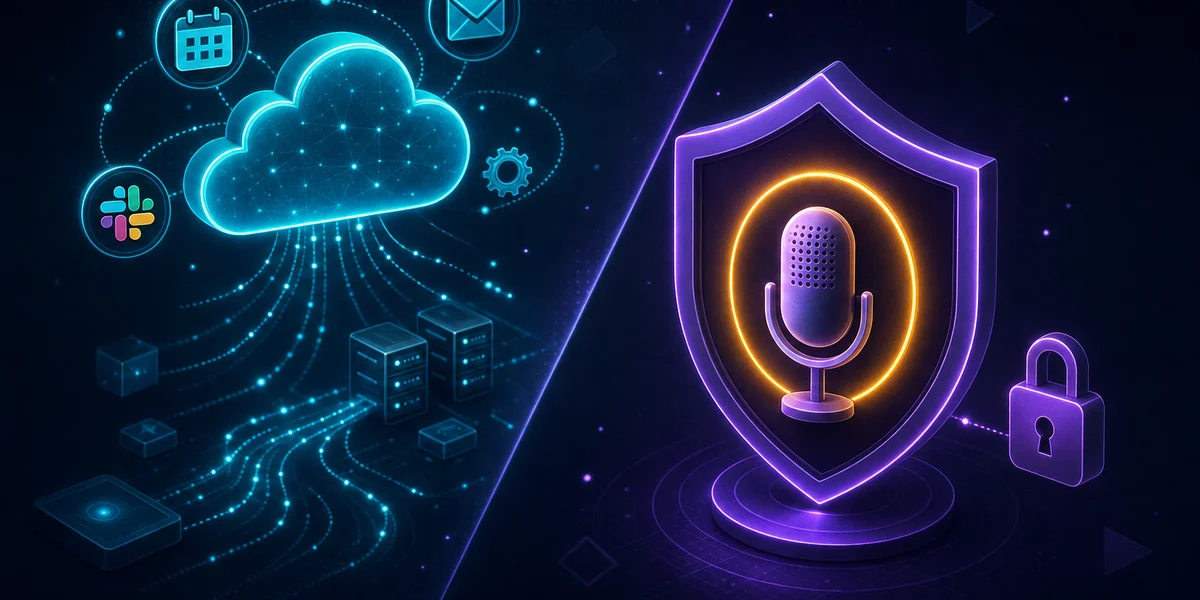
VoiceOS is a cloud-based dictation platform for Mac and Windows that combines voice typing with an agentic layer for Calendar, Gmail, and Slack. Priced at $12/month (or free for 100 uses/week), it claims a 350 ms latency and context-aware formatting that adapts tone per application. For users who want voice-triggered actions across apps, it is genuinely differentiated. For pure dictation or privacy-first workflows, offline tools cost less and process speech locally.
What Is VoiceOS?
VoiceOS is a voice-driven productivity platform that goes beyond traditional dictation. Where most dictation apps insert transcribed text into the active field, VoiceOS adds an “agent” capability — connecting to Calendar, Gmail, Slack, and other services to execute actions by voice from any app.
The product is positioned around a single promise: “Work 10× faster by eliminating app-hopping.” Instead of switching tools to send an email, schedule a meeting, or post to Slack, you speak the instruction and the agent executes it in the background.
Target audience: Knowledge workers and managers who juggle multiple SaaS tools daily — sales, customer success, founders, executive assistants. Less relevant for users who only need transcription, for offline workflows, or for environments with strict data residency requirements.
How Does VoiceOS Work?
VoiceOS combines speech recognition with a contextual AI layer that interprets intent. When you press the dictation shortcut, audio streams to VoiceOS cloud servers, which transcribe the speech and detect what application you are using. The output is then formatted appropriately for the target app.
Three modes drive the experience:
- Dictation mode — transcribes “what you meant, not what you said”, with automatic punctuation, grammar correction, and tone adaptation.
- Agent mode — connects OAuth integrations (Calendar, Gmail, Slack) and executes voice commands as cross-app actions.
- Ask mode and Edit mode — answer questions about on-screen content, or rewrite selected text by voice.
The underlying processing happens in the cloud. VoiceOS does mention “on-device processing with optional cloud sharing” on its homepage, but the agentic layer and most of the dictation pipeline depend on internet connectivity. This is the central trade-off of the product.
Context-Awareness: Does It Actually Adapt to Each App?
VoiceOS’s biggest technical claim is context-aware formatting — the app detects which application is in focus and adjusts the transcription style automatically.
In practice, this means:
- Gmail / Outlook — formal tone, proper salutations, paragraph breaks.
- Slack / Teams — conversational tone, no opening “Dear”, shorter lines.
- Code editors (VS Code, Cursor, Xcode) — recognises function names, camelCase, and code syntax.
- Google Docs / Word — full paragraphs with academic-style formatting.
The contextual layer is the most distinctive feature in the 2026 dictation market. Wispr Flow detects screen context for tone but does not execute actions; tools like Voicy and other cross-platform apps focus on universal coverage without app-specific behaviour.
The 350 ms transcription latency is also impressive on paper. Most cloud-based tools sit in the 500–800 ms range. Whether you perceive the speed advantage depends on your typing rhythm — fast speakers will notice, slower dictators may not.
VoiceOS Pricing in 2026
VoiceOS operates a three-tier pricing structure:
| Plan | Price | Usage | Best for |
|---|---|---|---|
| Free | $0 | 100 uses / week | Trial and casual use |
| Pro | $12 / month (billed annually) | Unlimited | Individual professionals |
| Enterprise | Custom | Unlimited + SOC 2 Type II + ISO 27001 | Regulated industries |
The Pro plan undercuts Wispr Flow ($15/month) by about 20 % while offering a comparable agentic layer. The free tier is generous — 100 voice actions per week covers light daily use and is enough to evaluate whether the agent integrations fit your workflow.
There is no lifetime plan, no one-time licence, and no public mention of a discounted student or non-profit tier.
VoiceOS vs Weesper Neon Flow
The two products solve different problems. Here is a direct comparison on the dimensions that matter most for professional buyers.
| Feature | VoiceOS | Weesper Neon Flow |
|---|---|---|
| Processing | Cloud | 100 % offline |
| Pricing | $12/month (Pro) | €5/month |
| Free trial | Free plan (100 uses/week) | 15-day free trial |
| Platforms | Mac, Windows | Mac, Windows |
| Languages | 100+ | 50+ |
| Latency | ~350 ms (cloud round-trip) | Local (no network) |
| Agentic actions (Calendar/Gmail/Slack) | ✅ | ❌ (pure dictation) |
| Context-aware formatting per app | ✅ | ✅ (via custom prompts) |
| Works without internet | ❌ | ✅ |
| Data leaves device | ✅ (cloud transcription) | ❌ (local only) |
| HIPAA / privileged data ready | Enterprise plan required | Yes (no transmission) |
| SOC 2 Type II / ISO 27001 | ✅ (Enterprise) | N/A (no cloud surface) |
Choose VoiceOS if: Your workflow is dominated by SaaS apps where voice-triggered actions save real time, and your data is not subject to strict residency or transmission rules.
Choose Weesper Neon Flow if: You handle sensitive data (medical, legal, financial), work in low-connectivity environments, or simply want fast, accurate dictation at less than half the price. Download Weesper to try the offline experience yourself.
Where VoiceOS Falls Short
After analysing the product page and public coverage, three limitations stand out.
1. No offline mode. VoiceOS is fundamentally a cloud product. Even the “on-device” note on the homepage refers to limited local capabilities — the agent layer, multi-app context awareness, and cross-language detection all require server processing. This is a hard blocker for regulated industries and travellers.
2. The agent layer adds attack surface. Granting OAuth access to Gmail, Calendar, and Slack means a third-party service can read and act on those accounts. SOC 2 Type II reduces but does not eliminate this risk. Organisations with strict data governance policies will need to evaluate whether the productivity gain justifies the integration footprint.
3. Pricing transparency is limited. The $12/month Pro plan is annual-billed only. Monthly billing pricing is not advertised on the main page, and the Enterprise plan requires a sales conversation. For comparison, pure dictation tools publish clear pricing across all tiers — see our voice dictation pricing comparison for the full landscape.
When Does Agentic Dictation Actually Help?
Agentic dictation provides clear value in specific workflows and adds complexity in others. The honest answer: it depends on whether you spend more time writing text or executing actions across apps.
High value: Account executives, customer success managers, founders, and executive assistants. Anyone who sends 30+ emails per day, schedules meetings constantly, and lives across Slack, Notion, and a CRM benefits from voice-triggered actions.
Limited value: Writers, journalists, lawyers drafting long documents, researchers, and developers writing code. These workflows reward pure transcription accuracy over cross-app automation. A simpler, faster, offline dictation tool delivers more value per dollar.
Edge case: Privacy-sensitive industries (healthcare, legal, finance). Agentic actions on sensitive data sources (patient records, privileged communications, financial transactions) introduce risk. Even with SOC 2 compliance, the legal and ethical bar for routing such data through a third-party service is high.
For a structured decision framework on choosing between agentic, cloud, and offline tools, see our comprehensive dictation software guide.
Should You Use VoiceOS?
Recommended if:
- You run a high-volume SaaS workflow (sales, customer success, executive).
- Calendar / Gmail / Slack consume more time than text drafting.
- Your data is not regulated and your network is reliable.
- The 350 ms latency advantage matters to your speaking pace.
Not recommended if:
- You handle confidential or regulated data (use offline tools instead).
- You work in environments with intermittent connectivity.
- You need pure dictation accuracy more than cross-app actions.
- You want the cheapest viable solution (Weesper is roughly half the price).
VoiceOS is a well-executed product in a specific niche — agentic productivity for cloud-native knowledge workers. It is not, despite the marketing, a universal dictation solution. Most professional dictation needs are still better served by tools that focus on transcription accuracy and privacy.
Conclusion
VoiceOS represents a credible attempt at “voice as a control surface” — moving dictation from text insertion to cross-app action. The agentic layer for Calendar, Gmail, and Slack, the 350 ms latency, and the context-aware formatting are genuine differentiators in a crowded 2026 market. At $12/month, it is reasonably priced for what it offers.
But the cloud-only architecture is a hard limitation for any workflow involving sensitive data, restricted networks, or strict cost discipline. For those use cases, offline-first alternatives remain the better choice. Weesper Neon Flow processes everything on-device, supports Mac and Windows, costs €5/month, and never transmits your voice anywhere — the strongest possible answer to the privacy and reliability questions that VoiceOS cannot.
Try the offline alternative: Start your free 15-day trial of Weesper Neon Flow — no credit card required. For setup help, browse our documentation and guides.