Direct answer — Is Monologue worth $15/month in 2026? Monologue is a polished, Apple-only dictation app from the media company Every, priced at $15/month or $144/year after a free tier capped at 1,000 dictated words. It is worth the money if you live entirely inside macOS and iOS, dictate across many languages, and are comfortable with your audio being processed by named third-party AI providers. It is the wrong buy if you touch Windows, or if offline needs to be the default rather than an opt-in.
What is Monologue, and who makes it?
Monologue is a voice dictation app for Apple devices, published by Every — the media and software company behind the Every newsletter.
Voice dictation is the conversion of spoken words into written text using speech recognition. Unlike a voice assistant, which executes commands, a dictation tool exists to produce accurate text and drop it where you are already typing.
Every announced Monologue publicly on 16 September 2025, after a private beta. The app was built by Naveen Naidu, described in the announcement as an Every “entrepreneur in residence”. It now sits in Every’s product suite alongside Cora, Spiral, Proof and Sparkle.
That provenance matters more than it usually would. A dictation app from a media business with an editorial reputation to protect is a different proposition from an anonymous binary, and Monologue’s documentation is unusually clear about what it does with your voice. That candour is worth crediting up front, because most of this review depends on it.
This Monologue review is based on the vendor’s published material — the site, the pricing page, the privacy policy and the terms — rather than a hands-on test. Where the published wording is ambiguous, we say so instead of guessing.
If you are still narrowing the category, our buyer’s guide to voice dictation software sets out the criteria that actually change the outcome.
How much does Monologue cost in 2026?
$15 per month billed monthly, or $144 per year billed annually. These are the figures published on Monologue’s own pricing page, and they are what you pay after the free tier runs out.
| Tier | Price | What it includes |
|---|---|---|
| Free | $0 | 1,000 dictation words, 10 recorded notes, offline transcription, context-aware formatting, 100+ languages |
| Pro, monthly | $15/month | Unlimited dictation, unlimited recorded notes, bot-free meeting notes |
| Pro, annual | $144/year | The same, at a $12/month equivalent |
| Every bundle | Not published on the pricing page | Monologue Pro plus Cora, Spiral, Proof, Sparkle and Every’s newsletter |
The advertised annual discount checks out, which is more than can be said for every vendor: $15 × 12 = $180 a year billed monthly, against $144 billed annually. That is exactly the 20% saving the page claims.
One number has moved since launch, and anyone budgeting from old coverage should know. Every’s September 2025 announcement quoted $10 per month as an early-bird standalone price. The live pricing page today says $15. The early-bird rate is gone, and third-party articles still quoting $10 are out of date.
The free tier also deserves a plain description rather than a marketing one. A cap of 1,000 dictated words is a demonstration, not a trial. Assuming a conversational delivery of 130–150 words per minute, 1,000 words is roughly seven minutes of talking before you hit the ceiling — enough to confirm the app installs and transcribes, not enough to learn whether it fits your working day.
For how monthly plans compare with paying once across this market, we ran the arithmetic in our breakdown of lifetime dictation deals.
Does Monologue process your voice on-device or in the cloud?
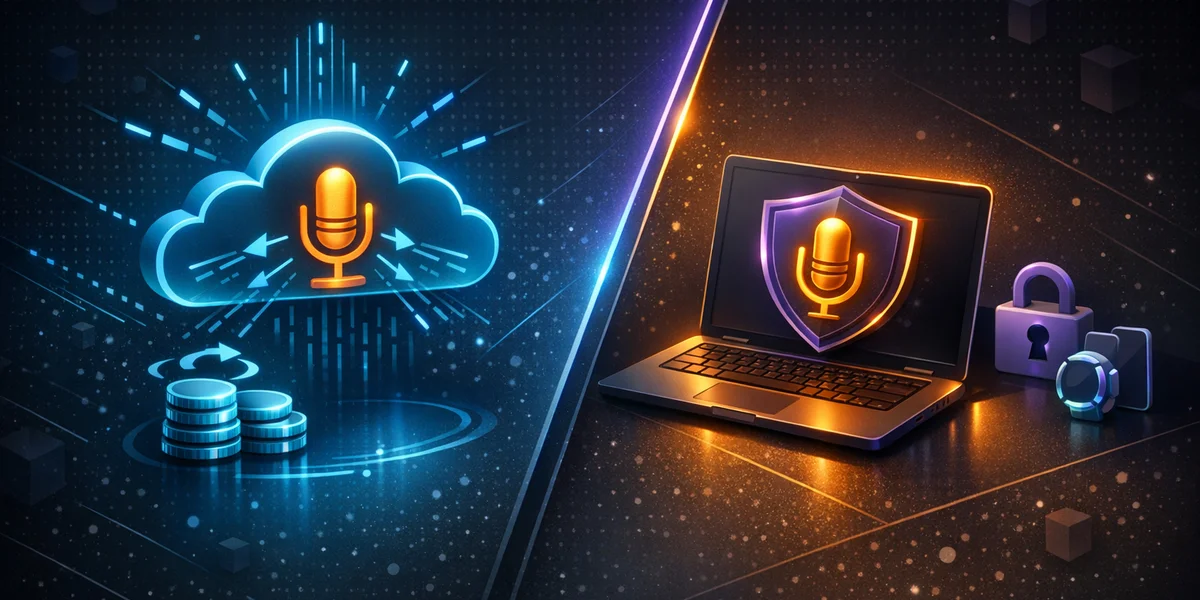
Both — but the cloud is the default, local is the option, and local exists only on Mac. This is the claim most reviews get wrong in one direction or the other, so here is precisely what Monologue publishes.
The cloud path. Monologue’s privacy policy names its Third-Party AI Providers as Groq, Fireworks and OpenRouter. Dictation is sent to them for processing. The policy states those providers employ a zero data retention approach, that Monologue itself does not store your audio files or transcripts on its servers unless you deliberately activate that logging with a toggle, and that it does not train any artificial intelligence models using your personal information, audio or transcripts.
The local path. The site states that Monologue offers local transcription models on Mac that can turn speech into text without an internet connection, and that smart formatting and syncing still require a connection.
Read that second sentence carefully, because the whole privacy story lives in it:
- Local transcription is real, and Monologue does not overclaim it.
- It is Mac-only. Your iPhone, iPad and Apple Watch have no local mode.
- Switching it on costs you smart formatting and cross-device sync — precisely the features that make the app feel clever.
So Monologue is not a privacy fraud, and calling it one would be lazy criticism. It publishes its subprocessors by name, which most of this market does not, and it commits in writing to not training on your voice. But it is not an offline-first tool either. Its best experience is a connected one, and the offline mode is a degraded fallback rather than the intended path.
Two further details belong in an honest assessment. Local audio files and transcripts on your device are deleted after 14 days. And the screen access is opt-in, not ambient: the optional Screen Recording permission exists so Monologue can capture system audio for bot-free meeting notes, while the terms note that users may, at their option, capture an image of the screen to improve the context of the transcription.
That distinction between a default and an option is the one that decides most purchases. Our comparison of on-device and cloud transcription covers what each model actually guarantees.
Which devices and languages does Monologue support?
Four devices, all Apple — and more than 100 languages.
Monologue publishes native apps for Mac, iPhone, iPad and Apple Watch. There is no Windows app, no Android app and no Linux app. For a household or a team that has standardised on Apple hardware, that is coherent rather than limiting, and the Apple Watch app is a genuine point of difference in a market where almost nobody ships one.
For anyone whose work touches a Windows machine, it is disqualifying, and no amount of polish compensates.
Language coverage runs the other way, and credit is due. Monologue advertises 100+ languages, with the ability to switch between them mid-flow — more than the 55+ languages Weesper Neon Flow covers. If you routinely dictate in a language outside the major European and Asian set, Monologue is more likely to have you covered.
If you are weighing Monologue against what Apple already gives you for nothing, our roundup of Apple dictation alternatives on Mac puts the built-in option in context.
Monologue vs Weesper Neon Flow: the honest comparison
The two products share a philosophy on quality and disagree on almost everything else. Monologue buys device breadth inside one ecosystem and pays for it with cloud dependence. Weesper Neon Flow buys on-device processing and cross-platform reach and pays for it in language count and mobile coverage.
| Feature | Weesper Neon Flow | Monologue |
|---|---|---|
| Platforms | macOS, Windows | Mac, iPhone, iPad, Apple Watch |
| Default processing | ✅ On-device (local Whisper) | ❌ Third-party AI providers (Groq, Fireworks, OpenRouter) |
| Offline dictation | ✅ Always | ⚠️ Optional, Mac only; loses smart formatting and sync |
| Languages | 55+ | 100+ |
| Pricing model | Subscription or one-time | Subscription only |
| Published price | €5/mo, €45/yr, €99 lifetime | $15/mo, $144/yr |
| Free entry point | 15-day trial | 1,000 words, 10 recorded notes |
| Meeting capture | — | Bot-free meeting notes (Mac) |
A note on the price row, because it is easy to misread: those are two different currencies and we are not converting them. Compare the shape of the cost, not an exchange rate you would have to invent.
The shape is this. Monologue’s annual plan is $144 per year, so $144 × 3 = $432 over three years, and the meter keeps running in year four. Weesper Neon Flow’s lifetime licence is €99 one-time, and the meter stops. Whether that trade is worth it depends entirely on whether you need Monologue’s phone, tablet and watch coverage — which Weesper does not offer at all.
If your work spans macOS and Windows, or you would rather your audio never left the machine in the first place, download Weesper Neon Flow and dictate a few real paragraphs before deciding.
What do Monologue’s subscription terms actually say?
They auto-renew, and the cancellation language is stricter than most readers will expect.
Monologue’s terms of service state that subscriptions automatically renew for an additional term of the same length upon expiration. They also reserve the right to change subscription fees at the end of the current term — which is exactly the mechanism that turned the $10 early-bird price into $15.
Two clauses are worth reading twice before you choose the annual plan:
- You will not be entitled to a refund for any past payments, or future payments due during the remainder of your cancelled term.
- If you cancel before the end of your subscription, you may be charged the entire remaining subscription fees at the time of cancellation.
None of this is unusual in subscription software, and it is not evidence of bad faith. But it is the practical difference between renting a tool and owning one: a $144 annual commitment is a $144 commitment, and cancelling early is not a refund mechanism.
Who should buy Monologue — and who shouldn’t
Buy Monologue if you:
- Work entirely on Apple hardware and want dictation on your phone, tablet and watch as well as your Mac.
- Dictate in languages outside the common European set, or switch languages mid-sentence.
- Want bot-free meeting notes that capture both sides of a call without adding a participant.
- Are comfortable with audio being processed by Groq, Fireworks or OpenRouter under a zero-retention policy.
Look elsewhere if you:
- Use Windows for any part of your working day.
- Need on-device processing as the default, not as a mode that costs you formatting and sync.
- Handle material under an NDA, clinical confidentiality or legal privilege that cannot leave the machine.
- Would rather pay once than commit to $144 a year indefinitely.
Our Help Centre documentation shows what a fully offline dictation workflow looks like day to day on macOS and Windows.
Frequently asked questions
What is Monologue?
Monologue is a voice dictation app for Apple devices, published by Every, the media and software company behind the Every newsletter. It was announced publicly on 16 September 2025 after a private beta and was built by Naveen Naidu, described in the announcement as an Every entrepreneur in residence. It runs on Mac, iPhone, iPad and Apple Watch, and sits alongside Cora, Spiral, Proof and Sparkle in Every’s product suite.
How much does Monologue cost in 2026?
Monologue Pro is $15 per month billed monthly, or $144 per year billed annually, which the pricing page describes as a $12 per month equivalent and a 20% saving. The arithmetic checks out: $15 x 12 = $180 against $144. There is a free tier capped at 1,000 dictation words and 10 recorded notes. Monologue Pro is also included in Every’s bundle subscription, whose price is not listed on the Monologue pricing page.
Does Monologue work offline?
Partly, and only on Mac. Monologue states that it offers local transcription models on Mac that can turn speech into text without an internet connection, but that smart formatting and syncing still require a connection. There is no local mode on iPhone, iPad or Apple Watch. By default, dictation is processed by named third-party AI providers, so cloud is the default path and local is the opt-in exception.
Which devices does Monologue support?
Four, all of them Apple: Mac, iPhone, iPad and Apple Watch. Monologue publishes no Windows, Android or Linux app. If any part of your working day happens on a Windows machine, Monologue cannot cover it, and no feature or price makes up for that. The Apple Watch app is unusual in this market and is a genuine point of difference.
Monologue vs Weesper Neon Flow: which should I choose?
Choose Monologue if you work entirely on Apple hardware, want dictation on a phone and a watch as well as a Mac, need more than 55 languages, and are comfortable with cloud processing as the default. Choose Weesper Neon Flow if you need Windows as well as macOS, want on-device processing by default rather than as an option, or prefer paying once instead of every month.
Can I get a refund if I cancel Monologue?
Monologue’s terms say no. They state that you will not be entitled to a refund for any past payments or future payments due during the remainder of your cancelled term, and add that if you cancel before the end of your subscription you may be charged the entire remaining subscription fees at the time of cancellation. Subscriptions also renew automatically. Read those clauses before committing to the annual plan.
Conclusion
Monologue is a good product with a narrow footprint and an honest privacy page. It covers more languages than most of its rivals, it reaches four Apple devices including a watch, and it names its subprocessors in public — which is rarer than it should be. For an Apple-only professional who dictates in several languages and wants meeting notes without a bot in the call, $15 a month is a defensible price.
The limits are structural rather than fixable by a discount. There is no Windows app. Local processing is a Mac-only mode that costs you the features you are paying for. And the free tier gives you roughly seven minutes of speech to make up your mind.
If your dictation spans macOS and Windows, or the audio genuinely cannot leave your machine, start your 15-day free trial of Weesper Neon Flow and test it on the work you actually do.