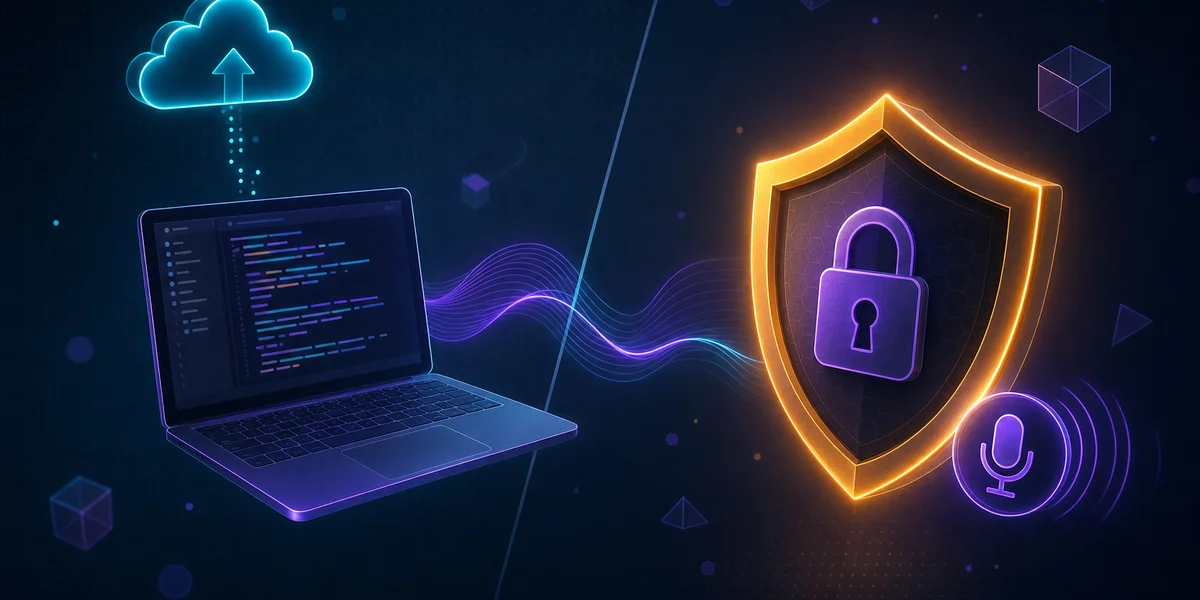
Direct answer — Is WhisperTyping a good dictation tool for Windows developers? WhisperTyping is a Windows-only dictation app that transcribes in the cloud and uses screen OCR to pick up class and function names from your editor. That context trick genuinely helps with code, and the app plugs into Claude Code, Cursor and GitHub Copilot. The trade-off is explicit: your audio leaves the machine. Offline tools keep it local.
Voice input stopped being a niche accessibility feature for developers the moment coding agents arrived. This WhisperTyping review takes the WhisperTyping vs Weesper question head-on and rates WhisperTyping dictation for a Windows engineering workflow: what screen OCR gets right, which tools it plugs into, what it costs, and where a cloud architecture starts to cost you something other than money. Talking to an agent is faster than typing a prompt, and a prompt does not have to compile — but the words you speak are still your client’s architecture. If you are already dictating to Claude Code, this is the comparison to read before you commit to a subscription.
What is WhisperTyping, and who is it built for?
WhisperTyping is speech recognition software for Windows 10 and 11, built on Whisper Large and shipped as a desktop application. There is no macOS or Linux build.
Voice dictation, for the purposes of this review, means converting continuous speech into text inserted at your cursor in whatever application has focus — as opposed to a voice assistant, which interprets speech as a command.
The vendor markets to several professions, but the developer angle is the one it pushes hardest, with dedicated setup pages for Claude Code, GitHub Copilot, Cursor, Aider, Codex CLI and ChatGPT.
What the free tier includes:
- 50+ languages
- Custom vocabulary
- Text replacements
- Automatic punctuation
- No credit card required
The paid tiers are where the developer-specific features live: AI modes that rewrite rough dictation into clean prose, reusable templates, and the screen OCR context engine.
How does WhisperTyping’s screen OCR help you dictate code?
It reads your screen so you do not have to spell out your own identifiers. The vendor’s developer page states that the app “uses OCR to read text from your screen, automatically recognizing class names, function names, and technical terms visible in your code editor.”
This is a real answer to a real problem. A general-purpose speech model hears useEffect as “use effect”, kubectl as “cube control” and your internal PaymentIntentReconciler as four unrelated words.
The usual fix is manual: open the vocabulary settings and register every framework, library and internal term you use. That works, but it is a chore you repeat on every new project.
Screen OCR short-circuits it. If the symbol is visible in your editor, the transcription has a much better chance of spelling it correctly without any setup.
There is a cost to that convenience, and it is worth naming. OCR reads whatever happens to be on screen — including the client codebase in the next split pane, the staging credentials in your terminal, and the ticket that is under NDA.
Which coding tools does it plug into?
Because the app types into the focused field at the operating-system level, it works anywhere Windows accepts keyboard input. The published integration pages cover:
- Claude Code
- GitHub Copilot
- Cursor
- Aider
- Codex CLI
- ChatGPT
These are setup guides rather than plugins. That is a strength: nothing breaks when your editor ships a new extension API. If you want the equivalent groundwork on the operating system itself, our Windows 11 dictation setup guide covers microphone permissions, hotkeys and the built-in alternatives.
What does WhisperTyping cost in 2026?
The pricing page publishes one billing view, and every paid card carries the same qualifier: billed annually.
| Plan | Published price | What it adds |
|---|---|---|
| Free | Free, no credit card | 50+ languages, custom vocabulary, text replacements, automatic punctuation |
| Personal | $5/mo billed annually | Unlimited minutes |
| Professional | $15/mo billed annually | Ultra accuracy mode, server priority, AI modes, screen OCR, templates, phone as wireless mic, email support |
| Medical | $30/mo billed annually | Medical-grade transcription, HIPAA compliance, premium support and onboarding |
| Business / Enterprise | Custom, 10+ licences | MSI installer, licence management, SSO, local transcription server |
Read that table with its scope attached. No month-to-month rate and no yearly total appear anywhere on the page, so those are annual-commitment rates — not what one month costs if you want to try the tool and leave.
Two things follow for a developer. The tier that unlocks screen OCR, the single feature that most justifies this app for coding, is the Professional plan. And on-device processing is not a paid upgrade on the consumer tiers: a local transcription server appears only in the Business and Enterprise bracket, quoted for 10+ licences.
Where does your audio go when you dictate code?
Off your machine, by design. The privacy policy is unusually clear about it: “We route your audio to cloud-based speech-to-text providers”, and “On our servers, audio is processed transiently and never stored in permanent memory.”
That is a reasonable, well-documented cloud posture. It is not the same thing as privacy, and the difference matters when the words you speak are a client’s architecture.
The policy also states that a detailed list of sub-processors is available on request. Under the GDPR, a processor may only engage another processor with the controller’s prior written authorisation, and Article 28 requires those arrangements to be set out in a contract. “On request” is workable for a solo developer and a genuine friction point for a security review at a regulated client.
There is also the plain engineering consequence. Cloud recognition needs a network round trip on every utterance, so latency tracks your connection, and dictation stops entirely on a plane, in a basement office or behind a VPN that blocks the endpoint.
Local transcription inverts all of this: nothing to authorise, nothing to disclose, nothing to lose when the Wi-Fi drops. We unpack the reasoning in detail in why offline dictation is better for privacy.
WhisperTyping vs Weesper Neon Flow: how do they compare?
Same job, opposite architectures. One sends your voice to a server to get better context; the other refuses to send anything at all.
| Weesper Neon Flow | WhisperTyping | |
|---|---|---|
| Platforms | macOS, Windows | Windows 10/11 |
| Where audio is processed | On your device | Cloud speech-to-text providers |
| Works with no internet | ✅ | ❌ |
| Screen OCR context | ❌ | ✅ (Professional and above) |
| Custom vocabulary | ✅ | ✅ |
| Languages | 50+ | 50+ |
| AI model | Whisper (local) | Whisper Large (cloud) |
| Billing | Monthly, yearly or one-time | Annual commitment |
| Free access | 15-day trial | Free plan, no credit card |
Weesper Neon Flow runs €5/month, €45/year or €99 as a one-time licence, with a 15-day trial and no recording length limit. Over three years the one-time licence works out at €99 total against €5 × 36 = €180 on the monthly plan.
Pick WhisperTyping if you work only on Windows, your code is not confidential, and screen OCR solves an identifier problem that a custom dictionary has not. Pick a local tool if your audio cannot leave the device, or if you switch between macOS and Windows. Another offline-first newcomer worth knowing about is Resonant, a privacy-focused dictation app for Mac and Windows, though its Windows build is still in beta. If cross-platform cloud dictation for developers is what you are after instead, Oravo AI covers macOS and Windows with similar code-aware formatting, though its own download page falls short of its advertised Linux support. You can try Weesper free for 15 days and dictate into your own editor before deciding.
Is dictation actually faster than typing for developers?
Faster for prose, not obviously faster for code — and the published evidence is narrower than the marketing suggests.
The clearest measurement compares speech to a touchscreen keyboard. In a study on an iPhone 6 Plus using Baidu’s Deep Speech 2, transcribing short English messages, speech input reached 153 words per minute against 52 for the iOS keyboard: 2.93 times faster (Ruan et al., arXiv:1608.07323).
Note every part of that scope before you budget a time saving. It measured short-message transcription, on a phone, in English and Mandarin, in a lab. It says nothing about typing const on a mechanical keyboard, and nothing about the seconds you spend fixing an identifier the model misheard.
Where the advantage does transfer is the natural-language half of the job, which is most of the writing a developer actually does:
- Prompts to a coding agent
- Commit messages and pull request descriptions
- Architecture decision records and design docs
- Docstrings, README sections and inline comments
- Code review replies and incident notes
Dictating for (let i = 0; i < n; i++) is theatre. Dictating the paragraph that explains why the loop exists is where the time comes back — so test any dictation tool on a week of your own commit messages and design docs, not on a vendor benchmark.
Which one should you choose?
WhisperTyping is a competently built, Windows-only dictation tool with one genuinely clever idea for developers — screen OCR that picks identifiers straight out of your editor. If you are on Windows, your work is not under NDA, and you are comfortable with an annual commitment, it is a reasonable pick.
The architecture decides the rest. Cloud recognition means a sub-processor chain to disclose, a network dependency to tolerate, and your voice on someone else’s servers. For confidential codebases, regulated clients or a mixed Mac-and-Windows setup, on-device transcription is simply the safer default. If you only need Windows and want a one-time price, our Whisperstream review covers a local alternative built on NVIDIA Parakeet.
Ready to compare on your own machine? Download Weesper Neon Flow and dictate your next pull request description offline, or browse the Help Center for hotkey and custom vocabulary setup.