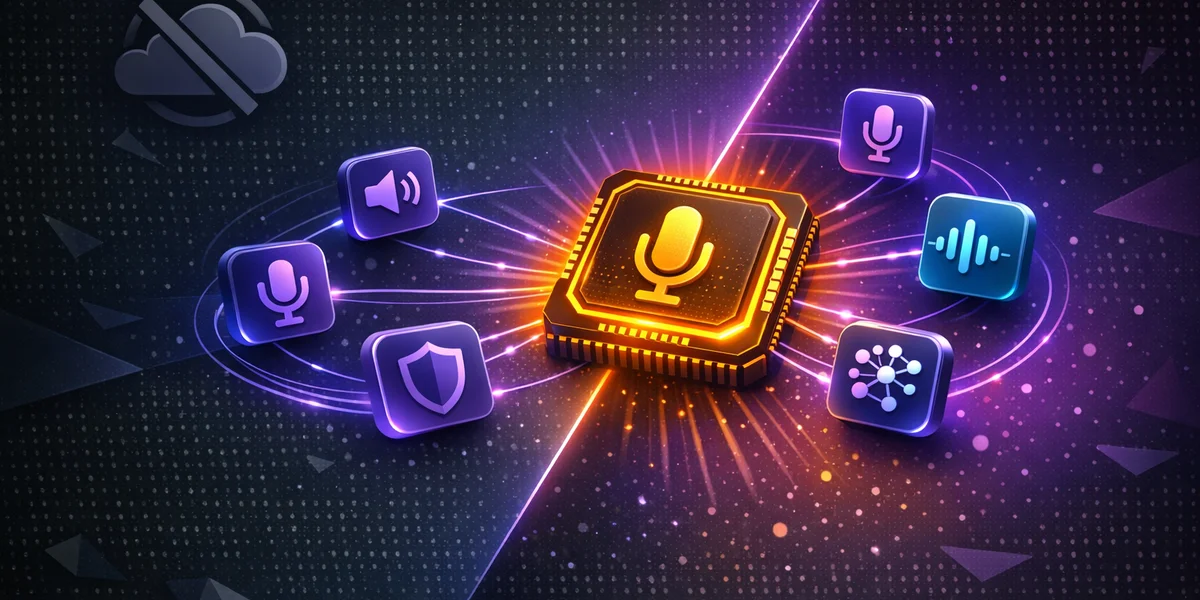
Direct answer — Which new offline speech recognition tools launched in 2026? The five most notable new offline dictation tools in 2026 are Google AI Edge Eloquent (offline dictation on iOS), Whisperstream (a Windows push-to-talk app built on NVIDIA Parakeet), OpenWhispr (an open-source cross-platform tool), EmberType (Mac-only, Whisper-based), and VoiceInk (open-source Mac dictation). All run speech recognition locally, keeping your audio on-device rather than sending it to the cloud.
Introduction
Offline dictation had a busy year. Throughout 2026, a wave of new speech recognition tools launched with one thing in common: they run locally, so your voice never has to leave your device. That shift matters for privacy, reliability, and working without an internet connection.
This roundup covers five recent launches worth trying, from Google’s surprise iOS entry to indie open-source projects. For each new dictation app in 2026, we cover what is genuinely new, which platforms it supports, whether it is truly offline, how much it costs, and who it suits best.
We keep the coverage honest. Some of these tools are excellent for specific setups, and none is perfect for everyone. If you want a cross-platform baseline to compare against, you can download Weesper free and test offline dictation on your own files while you read.
What counts as an offline speech recognition tool?
An offline speech recognition tool converts speech to text using models that run directly on your device, with no audio sent to remote servers. This is the defining feature of the latest offline dictation tools in 2026.
Speech recognition (also called speech-to-text or automatic speech recognition) is the technology that turns spoken words into written text. Offline or on-device processing means the recognition model runs locally, so transcription works without internet and keeps audio private.
Many popular tools are cloud-first: they stream your audio to servers for processing. The tools below take the opposite approach, prioritising local processing. A few offer optional cloud modes, so it is worth confirming the default before you rely on privacy claims.
Google AI Edge Eloquent: offline dictation lands on iOS
Google AI Edge Eloquent is a free, offline-first dictation app for iOS that Google quietly released on 7 April 2026. It runs Gemma-based speech recognition models locally after an initial download, with an optional cloud mode you can disable. For a closer look at how that Gemma model stacks up against Whisper, see our detailed Whisper vs Gemma 4 comparison for on-device dictation.
What is new in 2026 is that a major platform vendor shipped a genuinely offline dictation app. According to TechCrunch’s coverage, Eloquent automatically removes filler words like “um” and “ah”, and offers text transformations such as “Key Points”, “Formal”, “Short” and “Long”. It can even import keywords from Gmail to improve recognition of names and terms.
Google AI Edge Eloquent at a glance:
- What is new: Google’s first offline-first consumer dictation app, launched April 2026.
- Platforms: iOS (an Android version has been referenced but was not yet available at launch).
- Offline: Yes, after downloading local models. A cloud mode exists and can be turned off.
- Price: Free.
- Best for: iPhone users who want free, private dictation with AI text cleanup.
If you already use Eloquent on iOS and want an offline desktop companion for Mac or Windows, our Google Eloquent review goes deeper on its strengths and limits.
Whisperstream: on-device Windows dictation on NVIDIA Parakeet
Whisperstream is a Windows-only dictation app that runs entirely on your PC, using NVIDIA’s local Parakeet model rather than Whisper. It is a $29 one-time purchase and processes audio without any cloud connection. Our full Whisperstream review covers what stays local, what can reach the network, and how it compares with Weesper Neon Flow.
What stands out in 2026 is the choice of engine. Most new tools lean on OpenAI’s Whisper, but Whisperstream uses Parakeet, positioning itself for fast, local push-to-talk dictation. It supports 39 languages fully offline, adds AI cleanup that removes filler words and applies spoken corrections, and stores an encrypted local transcript history.
Whisperstream at a glance:
- What is new: Local Windows dictation built on NVIDIA Parakeet, not Whisper.
- Platforms: Windows only.
- Offline: Yes, “your voice never leaves your machine”.
- Price: $29 one-time for 1 PC or $49 for up to 2 PCs, with a 30-day money-back guarantee.
- Best for: Windows users wanting a low-cost, one-time-purchase offline dictation tool.
Whisperstream’s custom dictionary for names, jargon and acronyms is a practical touch. Its main limit is platform reach: there is no Mac version, so it does not suit mixed macOS and Windows workflows.
OpenWhispr: open-source, cross-platform, and free
OpenWhispr is a free, open-source voice-to-text app for macOS, Windows and Linux, with its code published on GitHub for anyone to inspect. It can run local AI models offline or connect to cloud providers using your own API keys.
The 2026 appeal is transparency plus reach. Because the code is public, privacy-conscious users can audit exactly how audio is handled. It works across apps like ChatGPT, Claude, Slack, Google Docs, Gmail and Teams, supports 100+ languages, and keeps transcription history stored locally with zero data retention.
OpenWhispr at a glance:
- What is new: Auditable open-source dictation across all three desktop platforms.
- Platforms: macOS, Windows, Linux.
- Offline: Yes for local models; optional cloud via your own API keys.
- Price: Free and open-source.
- Best for: Developers and privacy-focused users who want a free, inspectable tool.
The flexibility is real, but the hybrid local-plus-cloud design means you must configure it deliberately for offline-only use. For non-technical users, that setup burden is the main trade-off against a polished commercial app.
August 2026 update: TypeWhisper 1.0.7 strengthens local Windows dictation
TypeWhisper is a local-first, GPLv3 dictation app for macOS and Windows. Its core dictation remains free and open-source; optional commercial licences add cloud-folder sync, automatic correction learning, support and non-GPL terms, with individual plans starting at €5/month.
The official changelog dates the stable Windows 1.0.7 release to 10 August 2026. It adds Smart Formatting, regular-expression dictionary rules, spoken-number normalisation and interactive usage statistics. The release also improves interrupted-session recovery and clipboard restoration, and adds local Cohere Transcribe support alongside its existing model integrations. This is a meaningful update for users who want a free local core but need more control over formatting and specialised vocabulary.
EmberType: Mac-only Whisper dictation at $39
EmberType is a Mac-only dictation app built on OpenAI’s Whisper model, priced at $39 as a one-time payment. It processes audio offline on Apple Silicon, focusing on accurate raw transcription rather than AI rewriting.
For 2026, EmberType represents the polished, single-purpose end of the market: simple, private, on-device transcription for recent Macs. It requires macOS 14 or later on Apple Silicon (M1 or newer) and claims accuracy around 97% in its own testing, in line with typical Whisper Large-v3 results on clear English audio.
EmberType at a glance:
- What is new: Streamlined one-time-purchase Whisper dictation for Apple Silicon Macs.
- Platforms: macOS 14+ on Apple Silicon only (no Intel Macs, no Windows).
- Offline: Yes, audio stays on-device.
- Price: $39 one-time, with a 7-day free trial.
- Best for: Mac users who want simple offline transcription and a perpetual licence.
EmberType does not offer AI rewriting, custom prompts or Windows support. If you need those, a cross-platform option fits better. Our full EmberType review breaks down its accuracy and limits in detail.
VoiceInk: open-source Mac dictation with a one-time licence
VoiceInk is an open-source macOS dictation app built on whisper.cpp, licensed under GPL v3, with one-time pricing from $29 to $69. It runs Whisper models fully on-device and inserts dictated text system-wide, wherever your cursor is.
VoiceInk has matured through 2026 into one of the most active open-source options, with regular updates and a large GitHub following. It supports 100+ languages through Whisper models, offers a “Power Mode” for app-specific configurations, and keeps audio local unless you opt into cloud AI enhancement. You can also build it from source for free.
VoiceInk at a glance:
- What is new: Actively maintained open-source Mac dictation with tiered one-time pricing.
- Platforms: macOS 14.4+ (Apple Silicon).
- Offline: Yes via whisper.cpp; optional cloud enhancement is opt-in.
- Price: One-time — $29 (1 Mac), $49 (2 Macs), $69 (3 Macs); free if built from source.
- Best for: Mac users who value open-source transparency and a one-time payment.
Like EmberType, VoiceInk is Mac-only, so Windows users are left out. Its open-source nature is a genuine advantage for auditability, echoing the same whisper.cpp engine that powers other local tools.
How do the 5 new offline tools compare?
Here is a side-by-side comparison of the five 2026 launches, plus Weesper Neon Flow as a cross-platform reference point. The clearest differences are platform coverage, pricing model, and whether the tool defaults to local processing.
| Tool | Platforms | Offline by default | Price (2026) | Best for |
|---|---|---|---|---|
| Google AI Edge Eloquent | iOS | ✅ (cloud mode optional) | Free | Free iPhone dictation |
| Whisperstream | Windows | ✅ | $29 one-time (1 PC), $49 (2 PCs) | Low-cost Windows offline |
| OpenWhispr | macOS, Windows, Linux | ⚠️ Local or your-own-cloud | Free (open-source) | Auditable, all-desktop |
| EmberType | macOS (Apple Silicon) | ✅ | $39 one-time (1 Mac) | Simple Mac transcription |
| VoiceInk | macOS (Apple Silicon) | ✅ (cloud opt-in) | $29–$69 one-time | Open-source Mac users |
| Weesper Neon Flow | macOS, Windows | ✅ | €5/month, 50+ languages | Cross-platform privacy |
A few patterns stand out. Three of the five launches are single-platform, so cross-platform users have fewer choices. One-time pricing is common among the new tools, while subscriptions like Weesper trade a monthly fee for continuous updates and cross-platform support.
Which new offline tool should you choose?
Choose based on your platform first, then your priorities on price, privacy and features. There is no single best tool — only the best fit for your device and workflow.
A quick decision path:
- On iPhone? Google AI Edge Eloquent is a free, capable starting point.
- Windows only? Whisperstream offers a cheap, local one-time option.
- Want open-source and cross-desktop? OpenWhispr covers macOS, Windows and Linux.
- Mac only, one-time payment? EmberType or VoiceInk both fit, with VoiceInk adding open-source transparency.
- Switch between Mac and Windows? A cross-platform tool such as Weesper Neon Flow avoids running two separate apps.
One more entrant landed after this roundup was first published: VoicePad AI covers Windows, macOS, iOS and Android from a single vendor on one-time licences — the widest platform reach on this page — but ships full support for English and German only. Our VoicePad AI review sets out who that trade-off actually works for.
A second late arrival worth a mention: MacParakeet is a free, GPL-3.0 dictation app for Apple Silicon Macs that pairs system-wide dictation with file and meeting transcription. Our MacParakeet review covers what it does well and where a cross-platform tool keeps the edge.
The honest takeaway is that 2026 gave offline users more good choices than ever. If your work spans both macOS and Windows, or you want 50+ languages with custom-prompt AI cleanup at a low monthly price, try Weesper free for 15 days and compare it directly against these newcomers. For help picking the right local model for your hardware, our Help Center walks through the setup.
Conclusion
The new offline speech recognition tools of 2026 share a welcome direction: keeping your voice on your own device. Google AI Edge Eloquent brought offline dictation to iPhones, Whisperstream and the open-source OpenWhispr expanded the desktop options, and EmberType and VoiceInk gave Mac users polished on-device choices.
TypeWhisper’s Windows 1.0.7 update adds another local-first option to watch, especially for users who want open-source dictation with advanced formatting and dictionary controls on both desktop platforms.
Each tool wins for a specific setup, so match your pick to your platform, budget and privacy needs. If you want one consistent, offline, cross-platform tool that runs on both macOS and Windows, start your free trial and test Weesper Neon Flow against the 2026 launches on the documents and apps you actually use.