Google Eloquent (officially Google AI Edge Eloquent) is a free, offline-first dictation app for iPhone, launched quietly on 6 April 2026. It uses an on-device Gemma model to transcribe speech without an internet connection, removes filler words automatically, and offers optional cloud cleanup via Gemini. This Google Eloquent review covers the headline features, real-world performance, and how the app compares to Wispr Flow and Weesper Neon Flow on desktop.
What is Google AI Edge Eloquent?
Google AI Edge Eloquent is a free iOS dictation app that runs Google’s Gemma speech recognition model directly on your iPhone. There is no subscription, no usage cap, and no advertising.
Google released the app on 6 April 2026 with no press release, no marketing campaign, and no formal announcement — a notable departure from how the company usually launches consumer products. Coverage came from technology publications including TechCrunch, TNW, and 9to5Google rather than from Google itself.
The “AI Edge” in the name is a hint at its purpose. Eloquent sits inside Google’s AI Edge developer programme, which promotes on-device AI. The app is partly a real consumer product, partly a public demonstration of what Gemma can do without a network connection.
Headline features
- Offline-first transcription powered by a Gemma-based on-device ASR model
- Automatic cleanup of filler words (“um”, “ah”) and self-corrections
- Four text transformations: Key points, Formal, Short, Long
- Personal vocabulary that can optionally import frequent terms from Gmail
- Optional cloud mode using Gemini for richer text polishing
- Searchable transcription history stored locally on the device
- Free with no usage limits — no subscription, no advertising
The combination of “free”, “offline”, and “well-resourced model” is rare in the dictation market. Most competitors charge between $8 and $30 per month, and most still rely partly or fully on the cloud.
How well does Google Eloquent actually work?
Short answer: very well for casual mobile dictation, with the polish you would expect from a Google product, but with constraints typical of an iOS-only consumer release.
The Gemma-based ASR model produces clean, readable prose rather than verbatim transcripts. Filler words and stutters disappear automatically, which makes the output feel closer to a draft message than a literal transcription. For voice notes, emails on the move, and quick captures of ideas, this is genuinely useful.
The four transformation modes — Key points, Formal, Short, Long — are positioned as one of the app’s strongest differentiators. They turn raw dictation into bulleted summaries, more formal prose, condensed versions, or expanded explanations. Behind the scenes, the heavier transformations rely on Gemini in the cloud rather than on-device Gemma alone.
There are still rough edges. As of May 2026, the app is iOS-only, dictation happens inside the Eloquent app rather than system-wide, and Google has not published comprehensive language support details. The Android version is confirmed to be in development but has no announced date.
In day-to-day use, the experience falls into three distinct buckets. Short captures — voice notes, quick reminders, message drafts — are excellent. The cleanup is genuinely helpful, the latency feels native, and the offline default removes the awkward “is the network there?” hesitation. Medium-length dictation — paragraphs, emails, structured notes — also works well, particularly when the Formal transformation is applied at the end. Long-form work is where the app’s mobile origins start to show: dictating a 1,500-word draft on a phone is awkward regardless of how good the model is, simply because of the form factor.
Offline architecture, in plain English
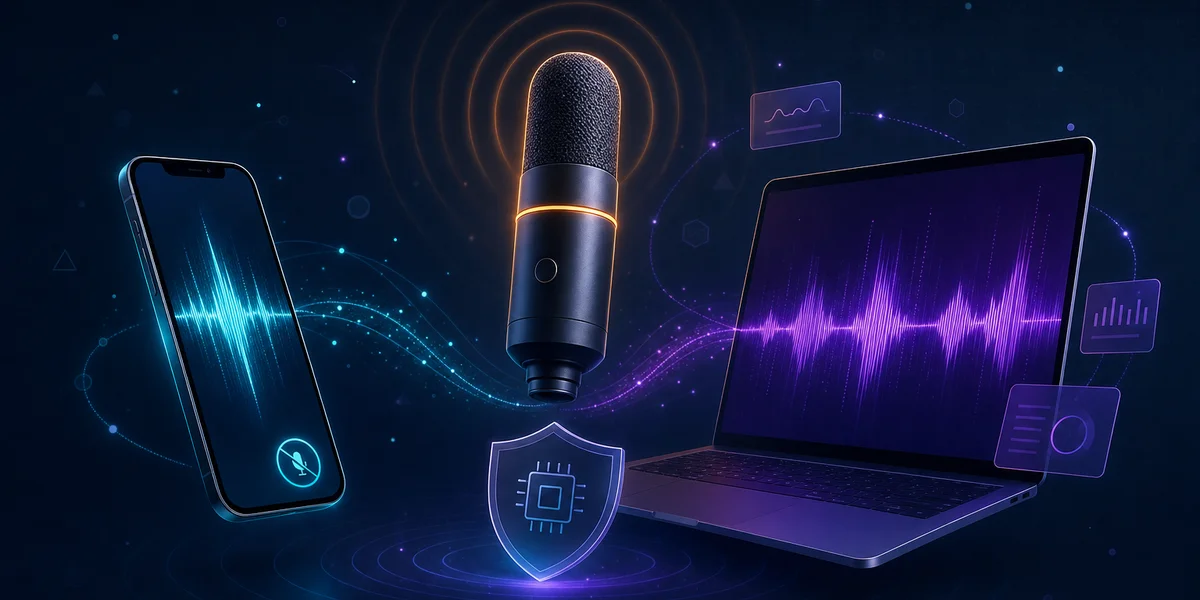
Eloquent illustrates how modern offline-first apps actually work. The Gemma ASR model lives in the app bundle and runs through Apple’s Neural Engine on supported iPhones. Audio is captured, processed locally, and discarded — nothing about that flow requires Google’s servers.
The cloud option is a separate, opt-in path. When you ask for the Long or Formal transformations and have cloud mode enabled, the cleaned text — not the original audio — is sent to Gemini for richer rewriting. If you turn cloud mode off, the heavier transformations either fall back to a more limited on-device version or become unavailable.
This split mirrors how Weesper Neon Flow handles a similar trade-off on desktop: whisper.cpp (an open-source on-device speech recognition engine) transcription is always local, while custom prompts can optionally use a remote model only when the user explicitly chooses. The shared principle is that offline should be the default, with cloud features as an optional, transparent addition rather than a hidden requirement.
Google Eloquent vs Wispr Flow vs Weesper: feature comparison
Eloquent enters a market already shaped by paid cloud apps such as Wispr Flow and offline desktop tools such as Weesper Neon Flow. The three products solve different problems on different platforms.
| Feature | Google Eloquent | Wispr Flow | Weesper Neon Flow |
|---|---|---|---|
| Platform | iPhone (iOS) | macOS + Windows | macOS + Windows |
| Processing | On-device Gemma (offline) | Cloud | Fully offline (on-device) |
| System-wide dictation | No — inside the app | Yes | Yes |
| Price | Free | ~$15/month | €5/month or €99 lifetime |
| Usage caps | None | Unlimited (paid) | Unlimited |
| Languages | English-focused at launch | 100+ | 50+ |
| Custom vocabulary | Yes (Gmail import) | Yes | Yes |
| AI text cleanup | Yes (Gemini cloud) | Yes | Yes (custom prompts) |
| Offline mode | Yes (default) | No | Yes (always) |
| Lifetime licence | N/A (free) | No | Yes (€99) |
| Best for | Free private mobile dictation | Pro desktop, cloud-OK | Pro desktop, privacy-critical |
The pattern is clear: Eloquent is a free mobile-first option, Wispr Flow is a cloud-based desktop subscription, and Weesper is an offline desktop alternative with a lifetime licence option. They overlap on the surface but rarely compete head-to-head for the same workflow.
Who should use Google Eloquent?
Use Google Eloquent if you mainly dictate on your iPhone, want a private, free option without subscriptions, and don’t need cross-app system-wide dictation. It is a strong upgrade over Apple’s built-in dictation for anyone writing notes, drafting messages, or capturing ideas on the move.
It is particularly compelling for:
- Students and casual users who don’t want to pay for dictation
- Privacy-conscious mobile users who like the idea of keeping audio on-device
- iPhone-first writers who already drafted text in Notes or email apps
- Anyone curious about on-device AI — Eloquent is one of the cleanest demonstrations of what Gemma can do today
It is less well suited for desktop work, dictating into other apps, professional workflows requiring 30+ languages, or anyone working primarily on macOS or Windows. For those scenarios, a dedicated desktop tool remains the right choice — see our comprehensive comparison of voice dictation software for the full landscape.
What Google Eloquent means for the dictation market
The launch is a major signal that on-device AI is mainstream. When Google itself ships a free Gemma-based dictation app on iOS, it validates everything the offline-dictation category has been arguing for two years: privacy, no subscriptions, and no network dependency.
The competitive ripples are already visible in pricing pages and feature roadmaps across the industry. Cloud-only paid apps now have to justify the trade-off more carefully — what does the subscription actually buy that a free, offline Google app cannot?
For desktop dictation specifically, Eloquent has limited direct impact because it does not exist on macOS or Windows. But it does change user expectations. A first-time desktop dictation buyer in mid-2026 will compare paid desktop apps not just against each other, but against the free experience they get on their phone. Tools that lean on opaque cloud processing or aggressive subscription tiers will feel harder to defend.
This is part of a broader shift covered in our analysis of Voxtral, Whisper, and the open-source speech model landscape, where capable on-device models are now reshaping product strategy across the entire voice AI market.
Three downstream effects are worth watching over the rest of 2026:
- Pricing pressure on cloud-only apps. Subscriptions priced at $15–$30 per month for what is now a free Google feature on iPhone will face harder questions, especially among casual users.
- Faster Android timeline. Once Eloquent reaches Android, the addressable market roughly triples, and competitors such as Wispr Flow, SuperWhisper, and Willow will have to position more sharply against a free default.
- Desktop is the next battleground. Mobile dictation is becoming a commodity. The remaining differentiation — system-wide integration, professional language coverage, AI text cleanup, custom workflows — sits squarely on desktop platforms.
Why a desktop alternative still matters
Eloquent is iPhone-only — most professional dictation still happens on a laptop or desktop. If you write long-form documents, code, legal briefs, medical notes, or technical reports, your dictation tool needs to live where you actually work: inside Word, your IDE, your EHR, your email client.
Weesper Neon Flow was built specifically for that scenario. It runs entirely on your Mac or Windows machine, uses whisper.cpp-based on-device processing, and works system-wide across any application. It supports 50+ languages, custom prompts for AI-style cleanup, and offers a lifetime licence at €99 for users who don’t want a recurring subscription. For Apple Silicon users, it leverages Metal acceleration to keep transcription fast even on laptops.
The most useful framing is this: Google Eloquent on the phone, a dedicated tool on the desktop. The two complement each other rather than compete. Eloquent handles voice notes between meetings; a desktop tool such as Weesper handles the actual writing.
For a deeper comparison with other cloud-based competitors, see our Wispr Flow review and Wispr Flow alternatives guide.
Verdict: a strong free option, with clear gaps
Google AI Edge Eloquent is a genuinely impressive iPhone dictation app. It is free, runs offline by default, uses a capable Gemma model, and adds smart text-transformation features that go beyond simple transcription. For mobile-first users, it is one of the best free dictation options launched in years.
It is also unmistakably a v1 product — iOS-only, English-focused, app-bound rather than system-wide, and limited on languages. Google has built the foundation; the rest of the platform coverage is presumably coming.
If you write professionally on a Mac or Windows machine, you still need a dedicated desktop dictation tool. If you write mostly on your iPhone and care about privacy, Eloquent is now the obvious starting point — and it costs nothing to try.
Ready to bring offline AI dictation to your desktop? Try Weesper Neon Flow free for 15 days and dictate privately across any application on macOS or Windows. Or browse our Help Center for setup guides, language tips, and custom prompt examples.