

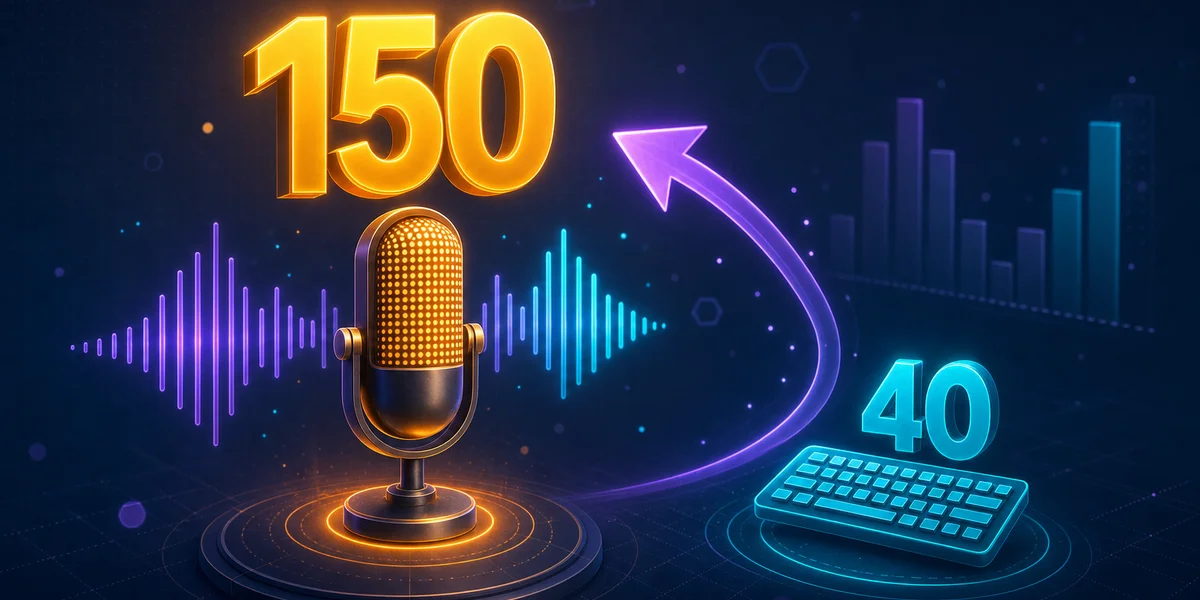
There is no single average speaking rate. The figure changes with the language, the population and the task being measured — and the number quoted everywhere online, 150 words per minute, describes dictation far better than it describes conversation. Measured across 2,438 American English telephone conversations, real conversational speech runs at 196 WPM over the total elapsed conversation and 236 WPM once silences are stripped out. English speakers dictating short messages into a phone were measured at 153 WPM; on the same phone’s keyboard they managed 52 WPM.
Introduction
Search for “average speaking rate words per minute” and the same number comes back everywhere: 150 wpm. It is repeated without a language, without a population and without a task — which is precisely what makes it useless. A rate measured on American English telephone calls does not transfer to Mandarin. A rate measured while dictating a text message does not describe reading a script aloud.
This article publishes only rates we could trace to a primary measurement, and states the scope of each one: which language, which population, which task. Where a widely quoted figure could not be traced, we say so instead of repeating it.
What Is the Average Speaking Rate in Words Per Minute?
The largest measurement we can verify comes from Jiahong Yuan, Mark Liberman and Christopher Cieri at the University of Pennsylvania’s Linguistic Data Consortium. Working on the word-aligned English Switchboard corpus — 2,438 telephone conversations in American English, nearly all between strangers — they report:
“we find an overall average rate of 196 words per minute (WPM). For individual conversations, the rate measured in this way ranges from 111 WPM to 291 WPM. If we use the word alignments to exclude silences, non-speech noises and so on, we find an average ‘net’ speaking rate of 236 WPM, with a minimum of 158 WPM and a maximum of 312 WPM.”
Three different numbers come out of the same recordings, and the difference is purely a matter of what you count:
| How the rate is measured | American English telephone conversation |
|---|---|
| Words ÷ total elapsed conversation time | 196 WPM (111–291 across conversations) |
| Words ÷ speaking time, silences excluded (“net”) | 236 WPM (158–312) |
| Words ÷ sum of each speaker’s turn times | 164 WPM |
That is the first thing to understand about speaking-rate data: quoting a single number without saying whether pauses were counted is meaningless. The same conversations yield 164, 196 or 236 WPM depending on the definition.
Scope: American English, adult volunteers, telephone conversation mostly between strangers, Switchboard corpus. It does not describe reading aloud, presenting or dictating, and it does not describe other languages.
How Does Speaking Rate Change by Context?
Rate changes with the task, and the tasks are not interchangeable. Here is every rate in this article with its full scope attached:
| Task | Language and population | Measured rate |
|---|---|---|
| Telephone conversation (total elapsed time) | American English, 2,438 conversations | 196 WPM |
| Telephone conversation (silences excluded) | American English, 2,438 conversations | 236 WPM |
| Dictating short messages into a phone | English, lab study, iPhone 6 Plus | 153 WPM |
| Dictating short messages into a phone | Mandarin Chinese, lab study, iPhone 6 Plus | 123 WPM |
| Typing short messages on a phone keyboard | English, lab study, iPhone 6 Plus | 52 WPM |
| Typing short messages on a phone keyboard | Mandarin Chinese (Pinyin), lab study | 43 WPM |
| Typing on a mobile device, general population | 37,370 volunteers, web transcription task | 36.2 WPM |
Conversation vs Dictation
Conversation is faster than dictation, not slower — the opposite of what most articles imply. In conversation you are reacting, overlapping and finishing each other’s sentences, with no device waiting on you. Dictation is composition: you are choosing words that will become written text, and you slow down accordingly. The gap between 196 WPM in conversation and 153 WPM dictating is exactly that difference.
What We Could Not Verify
Three figures circulate constantly in articles about speaking rate. We removed all three from this article because we could not trace any of them to a primary measurement we could obtain and check:
- 150–160 WPM for audiobook narration and podcasts. Traced through Wikipedia to a 1998 Human Factors and Ergonomics Society conference paper we could not obtain.
- 100–125 WPM for slide presentations. Traced through Wikipedia to a study-skills textbook, not to a measurement.
- ~250 WPM for auctioneers. Traced through Wikipedia to a marketing blog post.
They may well be reasonable rules of thumb. They are not data, and this article does not present them as data.
How Does Speaking Compare to Typing Speed?
The cleanest comparison comes from a Stanford, Baidu and University of Washington study that put both input methods on the same hardware — an iPhone 6 Plus — with the same task: transcribing short messages. The result:
“with speech recognition, the English input rate was 2.93 times faster (153 vs. 52 WPM), and the Mandarin Chinese input rate was 2.87 times faster (123 vs. 43 WPM) than the keyboard for short message transcription.”
| Input method | Language | Speed |
|---|---|---|
| Speech | English | 153 WPM |
| Speech | Mandarin Chinese | 123 WPM |
| Phone keyboard (Qwerty) | English | 52 WPM |
| Phone keyboard (Pinyin) | Mandarin Chinese | 43 WPM |
Two things are worth noting. First, the advantage is close to 3× in both languages, which is a strong sign the effect comes from the input channel rather than from anything specific to English. Second, 52 WPM is a laboratory keyboard speed on a controlled task. Across a much larger and less selective population, a study of 37,370 volunteers typing on their own phones found an average of 36.2 WPM with 2.3% uncorrected errors. Measured against that baseline, speech at 153 WPM is more than four times faster — a gap wide enough that professionals report dictating LinkedIn posts 3x faster than typing them out by hand.
Scope caveat: both studies measured short message entry, not drafting a long report, and neither used a modern on-device model. We explore the practical side of this trade-off in our guide to voice dictation versus typing speed.
How Voice Dictation Uses Your Natural Speaking Rate
Voice dictation works because it removes the keyboard bottleneck, not because it makes you speak faster. You produce words at whatever rate is natural for your language and your task; the software’s job is to keep up without forcing you to slow down.
Weesper Neon Flow is built around this principle. It transcribes continuous speech at conversational pace using whisper.cpp-based models, so you never have to talk slowly or robotically. Because it runs 100% offline, audio is processed locally on your Mac or Windows machine and never leaves your device.
Key reasons natural-rate dictation works well with Weesper:
- No artificial pauses needed — speak in full sentences at your natural pace
- Offline processing — no internet lag, no cloud upload, complete privacy
- 50+ languages — dictate in your native tongue at native speed
- No time limits — dictate for as long as you need
- Metal acceleration on Mac — GPU-powered speed for real-time transcription
For professionals who write a lot — lawyers, doctors, journalists, writers and developers — closing the gap between keyboard entry and dictation is worth hours every week. Accuracy matters too; if you want consistently clean transcripts, see our tips on improving voice dictation accuracy.
You can try Weesper free for 15 days with no credit card required, and read more about the science of speech recognition in our Help Center.
Practical Takeaways for Your Own Speaking Rate
Published averages tell you what one population did in one laboratory. They do not tell you your own rate, which is the only one that matters for your workflow.
- Measure yourself rather than adopting an average. Use the free Dictation Speed Test to get your own baseline, in your own language.
- Compare like with like. Your conversation rate, your dictation rate and your reading-aloud rate are three different numbers. Do not plan around one and then measure another.
- Expect a range, not a point. Even within a single corpus of one language and one task, individual conversations ranged from 111 to 291 WPM. A single “correct” number does not exist.
- Do not slow down for the software. Modern dictation tools are built for continuous speech at natural pace. If you find yourself over-articulating, that is a tool problem, not a speaking problem.
Conclusion
The honest answer to “what is the average speaking rate” is that it depends on what you measure, and most published figures never say. The rates we can verify are 196 WPM for American English telephone conversation, 153 WPM for English dictation of short messages, and 36 WPM for typing on a phone.
The gap between the last two is the one that matters. Whether you call it 3× or 4×, dictation removes the keyboard as the limit on how fast you can put words on a page.
Ready to write at the speed of speech? Download Weesper Neon Flow and start dictating at your natural pace today, or explore our setup guides to get the most accurate results.