Direct answer: Voice dictation in Spanish converts your spoken words into written text using speech-recognition models trained on Spanish-language audio. In 2026, modern engines reach 94–97% accuracy on clean audio (3–6% word error rate) and work in both Castilian and Latin American variants. The best choice depends on three things: do you need offline privacy, do you work in multiple Spanish dialects, and do you dictate professional content that must never leave your device.
Spanish is the world’s second-most-spoken native language, yet most dictation guides are written for English. This article fills that gap. We cover what voice dictation actually does, how 2026 engines perform on Spanish audio, the trade-offs between offline and cloud tools, and how to choose the right app for your workflow — whether you write emails in Madrid, draft medical notes in Mexico City or interview sources in Buenos Aires.
The primary keyword dictado por voz (voice dictation) covers a broad family of tools: free browser typing, paid desktop apps, professional medical dictation systems, and modern Whisper-based applications that run entirely offline. By the end of this guide you will know which category fits your needs and what to look for in a Spanish-first dictation app.
What is voice dictation and how does it work in Spanish?
Voice dictation is the process of speaking into a microphone and having software transcribe your speech into typed text in real time. In Spanish, the workflow is identical to English but the underlying acoustic model must be trained on Spanish audio to recognise sounds such as the rolled “r”, the soft “c” used in Castilian Spanish, or the distinct “ll” pronunciation across regions.
Modern Spanish dictation relies on two technical building blocks:
- An acoustic model that maps audio waveforms to Spanish phonemes — the basic sounds of the language.
- A language model that picks the most likely Spanish word sequence (for instance “voy a comer” rather than “boy a comer”, which sound nearly identical).
The 2026 generation of models — including OpenAI’s Whisper and its open-source derivative whisper.cpp — handles both steps in a single neural network. This is why Spanish performance has improved dramatically compared with the rule-based systems of the 2010s.
Why Spanish dictation has improved in 2026
Three factors converged in the past two years. First, training data quality jumped: the Common Voice corpus now includes thousands of hours of crowd-sourced Spanish audio across regional accents. Second, model architectures became more efficient, making local inference fast enough to run on consumer laptops. Third, dedicated Spanish-tuned variants emerged, narrowing the gap with English performance.
How accurate is Spanish voice dictation in 2026?
Spanish reaches 3–6% word error rate (WER) on clean audio with current Whisper-class models, which translates to roughly 94–97% accuracy — close to English parity. This makes Spanish a Tier 1 language alongside English, French, German, and Italian according to public Whisper benchmarks.
Real-world accuracy depends on three variables: microphone quality, ambient noise, and how distinctive your accent is relative to the training data. A USB headset in a quiet room consistently delivers above 95% accuracy. A laptop microphone in an open office may drop to 88–92%.
| Model / Tool | Type | Spanish WER (clean audio) | Notes |
|---|---|---|---|
| Whisper Large-v3 | Open-source neural | ~2.7% (best case) | State-of-the-art, runs offline via whisper.cpp |
| Whisper Medium | Open-source neural | 4–6% | Used by most local apps |
| Whisper Small | Open-source neural | 6–9% | Faster, smaller footprint |
| Whisper Tiny | Open-source neural | 10–15% | For low-resource devices only |
| ElevenLabs Scribe (cloud) | Cloud API | 3.1% (FLEURS benchmark) | Cloud-only, no offline mode |
| Google Docs voice typing | Cloud | ~5–8% | Free, browser-based, requires Google account |
Sources: NovaScribe Whisper benchmark, FLEURS benchmark for ElevenLabs Scribe.
What are the best Spanish voice dictation apps in 2026?
The best Spanish dictation app depends on whether you prioritise privacy, regional accent support, or zero-cost browser typing. The four categories below cover almost every use case in 2026.
Offline desktop apps (privacy-first)
Offline apps run the speech-recognition model directly on your laptop. Your audio never reaches the internet. Weesper Neon Flow falls in this category: it uses whisper.cpp locally, supports 50+ languages including all major Spanish variants, and costs €5 per month. The privacy guarantee is structural — there is no server to leak your data.
OpenWhispr is the open-source alternative in this category. Setup is more technical and Spanish accuracy is reported at 85–90%, slightly below tuned commercial offerings, but it is free.
Cloud-based dictation services
Cloud apps send your audio to a remote server for transcription. They typically offer the highest peak accuracy and the slickest mobile experience, but every sentence you dictate leaves your device. Notable Spanish-capable cloud tools include Notta, Sonix and ElevenLabs Scribe. They suit users who do not handle sensitive content and value polished apps.
Built-in OS dictation
Both macOS and Windows include a free Spanish dictation feature. macOS Tahoe’s built-in dictation handles Castilian and Mexican Spanish well; Windows 11 includes a dictation toolbar (Win + H) with Spanish support. Quality is decent but feature depth (custom vocabulary, prompt-based formatting) is limited compared with dedicated apps.
Browser-based free tools
Google Docs voice typing, Dictation.io and similar browser tools handle Spanish reasonably well for casual notes. They require an internet connection, route your audio through the provider’s servers, and have limited integration with desktop applications. Suitable for quick capture, not professional workflows.
Offline vs cloud Spanish dictation: which should you choose?
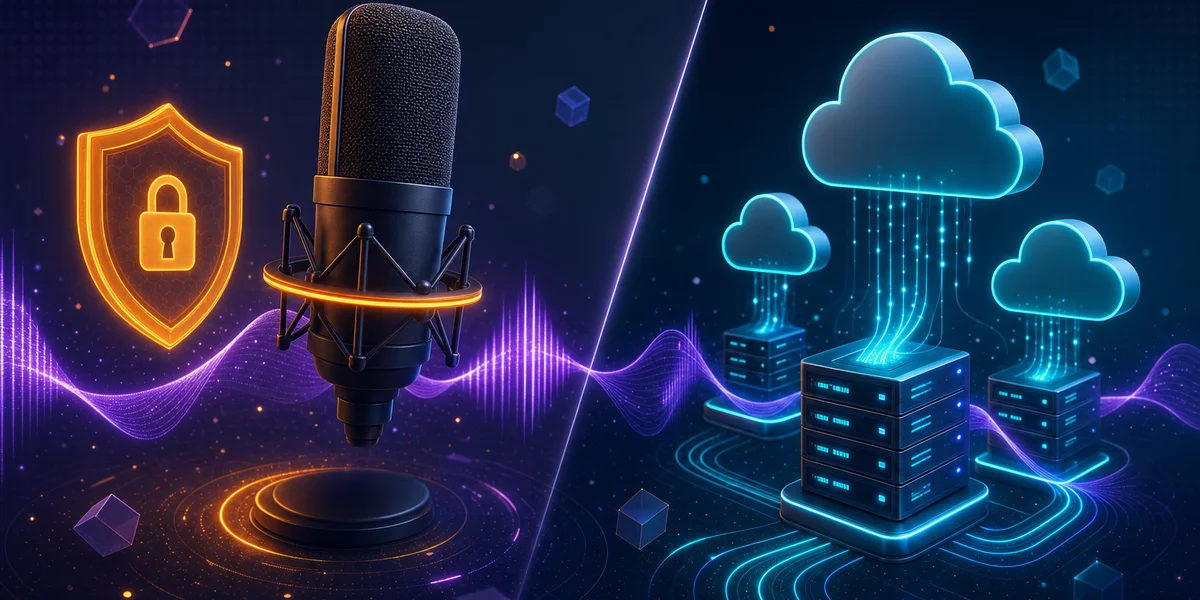
Choose offline Spanish dictation if you handle confidential content, work without reliable internet, or want predictable monthly costs. Choose cloud if you need cross-device sync, voice commands tied to your account, and you do not work with regulated data.
| Factor | Offline (e.g. Weesper Neon Flow) | Cloud (e.g. Notta, Sonix) |
|---|---|---|
| Audio sent to internet | No — runs locally | Yes — sent for transcription |
| Internet required | No | Yes |
| Spanish accuracy | 94–97% (Whisper Medium/Large) | 95–97% (top cloud APIs) |
| Latency | < 1 second on modern Mac/PC | 1–3 seconds (network dependent) |
| Per-month cost (typical) | €5 flat | €10–30 with usage limits |
| GDPR data-minimisation | Compliant by default | Requires DPA review |
| Works on a plane | Yes | No |
For Spanish-speaking professionals in regulated industries — lawyers in Madrid, doctors in Buenos Aires, accountants in Mexico City — offline dictation is the only configuration that keeps client data inside your device. We covered this trade-off in depth in our enterprise security and compliance guide.
How do I set up Spanish voice dictation effectively?
Effective Spanish dictation depends on three steps: picking the right Spanish locale, learning a handful of punctuation commands, and adding a custom vocabulary for terms your software does not recognise.
-
Pick your Spanish variant. In Weesper Neon Flow and most modern tools you can leave language detection automatic. If you mix variants — for example a Mexican professional writing for a Spanish audience — use a specific locale (es-ES or es-MX) to get more consistent vocabulary choices.
-
Learn the punctuation commands. The basics in Spanish are punto (.), coma (,), signo de interrogación (?), signo de exclamación (!), nueva línea (line break) and nuevo párrafo (new paragraph). Five minutes of practice transforms your output.
-
Add specialist vocabulary. Medical, legal and technical terms need a custom dictionary. Weesper supports custom prompts where you list domain terms — useful for medical Spanish (vocabulary such as “ecocardiograma”, “hemoglobina”) or legal Spanish (“habeas corpus”, “usufructo”).
-
Use a decent microphone. A €30 USB headset doubles accuracy compared with a built-in laptop mic. This applies to every language but particularly to Spanish, where laptop microphones often confuse “b” and “v” sounds.
For deeper accuracy tips, see our Spanish-language accuracy improvement guide.
What about Spanish dictation on mobile devices?
Mobile Spanish dictation has caught up with desktop in 2026, but the trade-offs are different. iOS and Android both ship with capable Spanish voice typing, available in any text field via the keyboard’s microphone icon. Apple’s on-device dictation runs offline on modern iPhones; Google’s Gboard voice typing routes through Google servers by default but can be set to on-device mode on Pixel devices.
For professional mobile workflows the limits are screen size, keyboard friction, and battery life — not raw accuracy. Most Spanish-speaking professionals use mobile dictation for capture (notes, ideas, voice memos) and desktop dictation for production (emails, reports, articles). We covered the best dictation apps for mobile in our best dictation apps for iPhone and Android guide.
What should Spanish speakers look for when choosing dictation software?
Spanish speakers should check four criteria beyond raw accuracy: regional accent support, custom vocabulary, offline mode, and pricing model. These factors matter more than marketing claims about “99% accuracy” — every vendor claims that.
- Regional accent support. Confirm the tool handles your specific variant (es-ES, es-MX, es-AR, es-CO, es-419). A tool tuned only on Castilian may underperform on Argentinian voseo.
- Custom vocabulary for Spanish. Spanish technical terms with accents (e.g. función, teléfono) need accurate diacritic handling. Test a sample before subscribing.
- Offline mode. If you might ever need to dictate confidential content, pick a tool with a real offline mode. Cloud-only apps cannot be retrofitted with privacy guarantees.
- Pricing model. Subscription pricing (€5–10 per month) is the dominant 2026 model. Watch for usage caps measured in audio hours per month — these matter more in Spanish where words-per-minute is high.
For a methodical decision framework see our how to choose voice dictation software guide, which walks through ten evaluation criteria step by step.
Conclusion: voice dictation in Spanish is ready for professional work
Spanish voice dictation is no longer a compromise. With 94–97% accuracy on clean audio, offline mode on consumer hardware, and pricing well below €10 per month for serious tools, dictation is faster, healthier (no repetitive strain injuries) and often more accurate than typing for Spanish speakers.
If you handle confidential content or want a predictable, privacy-first workflow, try Weesper Neon Flow — it runs Spanish dictation entirely offline on macOS and Windows, supports every major Spanish variant, and includes a 15-day free trial.
Download Weesper Neon Flow for free and start dictating in Spanish today.
Need help configuring custom Spanish vocabulary or switching dialects? Visit the Weesper Help Center for step-by-step guides.