
Direct answer — Should a programmer with RSI choose Talon Voice or Weesper Neon Flow?
Choose Talon Voice if your hands need to stop touching the keyboard and mouse entirely: it replaces both with scripted voice commands, noises and optional eye tracking, at the cost of weeks of practice. Choose Weesper Neon Flow if you mainly need to offload prose — commits, reviews, docs, AI prompts — with no setup, offline. Many developers run both.
Searching for a Talon Voice alternative usually starts in the same place: wrists or elbows that hurt, and a job that is made of keystrokes. The choice of voice coding tool for RSI in 2026 is less about which product is “better” and more about how much of your input you need to move away from your hands.
This comparison of Talon Voice vs Weesper is deliberately narrow. If you want the wider picture of dictation for developers with repetitive strain injury, our guide to voice dictation for developers with RSI covers the workflow, the keystroke budget and the confidentiality side. Here, we put two very different tools side by side and say plainly where each one wins.
What is Talon Voice, and how does it differ from dictation?
Talon Voice is a hands-free input system that replaces the keyboard and mouse with spoken commands, noises and eye tracking. Its official documentation says it “aims to bring programming, realtime video gaming, command line, and full desktop computer proficiency to people” who cannot or should not use their hands.
The key difference from a dictation app is the default mode. Talon listens for commands: short spoken phrases mapped to actions. Blake Watson, a developer with spinal muscular atrophy who uses Talon daily, explains that it “does no transcribing by default”; continuous text goes through a separate dictation mode.
According to Talon’s official reference and the community repository, the core building blocks are:
- Scripting — commands live in
.talonfiles and Python; Talon is “scriptable with Python 3 (via embedded CPython)”, so you do not install Python yourself. - A community command set — the MIT-licensed
talonhub/communityrepository provides the default grammar. Its README gives the classic example: sayair bat capto insertabc. - Speech engines — Talon “comes with a free speech recognition engine” (Conformer, installed from the Speech Recognition menu) and is also compatible with Dragon.
- Noises — a “noise recognition system (pop and hiss)”, typically used to click and scroll without speaking.
- Eye tracking — mouse control through a Tobii 4C, Tobii 5 or equivalent eye tracker.
On top of Talon, the open-source Cursorless project adds “a spoken language for structural code editing” as a VS Code extension. Its README states that it “currently depends on Talon”.
What is Weesper Neon Flow built for?
Weesper Neon Flow is an offline dictation app for macOS and Windows: you press a hotkey, speak, and the transcription is inserted into whichever text field has focus. Recognition runs on a local Whisper model, so no audio leaves the machine.
It is not a command system, and we would rather say so up front. Our own help centre is explicit that Weesper “does not yet interpret advanced contextual commands” such as “select the previous line” or “run this command” — see raw dictation settings for code and terminals. What it offers developers is narrower and requires no grammar to learn:
- A custom dictionary for service names, libraries and acronyms, plus replacement rules (a spoken phrase can become a line break).
- Text cleanup, including an option that removes the final full stop only in editors and terminals.
- System-wide insertion into the IDE, the terminal, the browser, Slack or an AI assistant’s prompt box.
- Simple pricing: €5/month, €45/year or €99 one-time, with a 15-day free trial.
Talon Voice vs Weesper: how do they compare feature by feature?
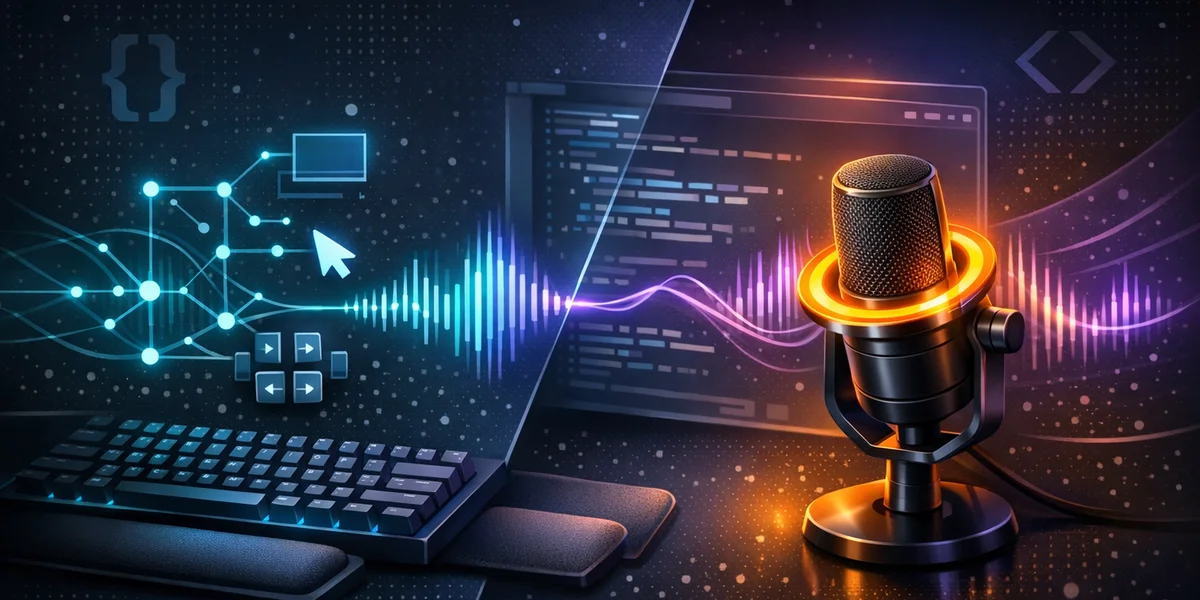
The short version: Talon covers control, Weesper covers prose. The table below uses Talon’s official documentation and Weesper’s published product facts.
| Talon Voice | Weesper Neon Flow | |
|---|---|---|
| Primary job | Hands-free control of the whole computer | Speech-to-text dictation |
| Default listening mode | Commands | Dictation |
| Writes code syntax by voice | ✅ via command grammar (and Cursorless) | ❌ |
| Mouse replacement | ✅ eye tracking, pop/hiss noises | ❌ |
| Setup before first use | Install engine + community scripts, learn commands | Install, pick a hotkey, dictate |
| Customisation | Python and .talon scripts | Dictionary, replacements, text cleanup |
| Platforms | Windows, macOS, Linux (X11) | macOS, Windows |
| Recognition | Built-in Conformer engine or Dragon | Local Whisper model, offline |
| Price | Not quoted on talonvoice.com; optional Talon+ via Patreon | €5/mo, €45/yr or €99 one-time |
Talon’s site presents its Patreon tier, Talon+, with the line “More features. Better support.” Talon’s site quotes no price, so we state none here; check the Patreon page for current terms. Talon’s official reference does not state whether every engine runs fully offline, so we make no claim either way.
Where does Talon Voice clearly win?
Talon wins whenever the goal is zero hand use. If a clinician has told you to stop typing and stop using the mouse, a dictation app solves only part of the problem, because navigation, selection, refactoring and window management remain manual.
That is where Talon is unmatched:
- Syntax and identifiers. Spelling
getUserByIdor a regular expression by voice needs a grammar for letters, casing and symbols — exactly what the community command set provides. - Navigation and editing. Jumping to a line, selecting a block or running a build are commands, not text.
- Pointer control. Eye tracking plus pop and hiss replaces the mouse, which a dictation tool cannot do.
- Linux. Talon supports Linux on X11; Weesper Neon Flow does not run on Linux.
The trade-off is the Talon Voice learning curve. Josh W. Comeau, who moved to Talon and a Tobii 5 eye tracker after developing cubital tunnel syndrome in both elbows, estimated he was working at “about 50% of my normal speed” and noted that “it took years to become proficient with a keyboard”. Blake Watson concedes the curve “may seem steep” and credits the community for making it manageable.
Where does Weesper Neon Flow clearly win?
Weesper wins when the strain comes mostly from writing English, and when you need relief today rather than in a month. There is nothing to configure before the first sentence: install, choose a hotkey, speak.
For many developers, prose is a large share of the keystrokes in a week:
- commit messages and pull request descriptions;
- code review comments, tickets and incident notes;
- documentation, READMEs and architecture decision records;
- Slack messages and emails;
- prompts to AI coding assistants — see our guide to dictating prompts for vibe coding.
Dictating that text in a command system means switching into dictation mode and back for every message. In Weesper it is the default, and because recognition is local, internal service names and unreleased features you mention never reach a vendor’s server. To try it on your next pull request, start the 15-day free trial.
Can you combine Talon Voice and Weesper Neon Flow?
Yes, and for many programmers with RSI this is the most practical setup. Let each tool do what it is designed for, and make sure only one is listening at a time.
A workable split looks like this:
- Talon for control — navigation, selection, symbols, identifiers, terminal commands and the mouse.
- Weesper for long text — anything longer than a sentence or two, in any application.
- One trigger rule — put Talon to sleep (or use a command bound to Weesper’s hotkey) before dictating, then wake it again.
- Shared vocabulary — add your project’s names to Weesper’s custom dictionary so prose and code use the same spelling.
One caution applies to both tools: speaking all day is a new load of its own. Comeau writes that his biggest issue was voice strain — “I’m not used to talking for 8+ hours a day!” — so build breaks into a voice workflow just as you would into a typing one.
Which hands-free coding voice control setup should you pick?
Pick according to what your hands can still do, not according to a feature count. These rules of thumb cover most cases:
| Your situation | Best fit |
|---|---|
| You cannot use keyboard or mouse at all | Talon Voice (plus eye tracker) |
| You can type a little, but prose is what hurts | Weesper Neon Flow |
| You work on Linux | Talon Voice |
| You need relief this week, with no learning period | Weesper Neon Flow |
| You write lots of code and lots of documentation | Both, with a clear trigger rule |
| Your employer forbids sending audio to third parties | Weesper Neon Flow (offline by design) |
If you are still comparing dictation apps rather than command systems, our comparison hub sets Weesper against other dictation tools on price, platforms and offline processing.
Conclusion
Talon Voice and Weesper Neon Flow are not really rivals. Talon is the strongest option for complete hands-free coding — syntax, navigation and mouse replacement — if you invest the weeks it takes to learn. Weesper Neon Flow is the fastest way to move the English half of a developer’s day off the keyboard, offline and without a grammar to memorise.
If prose is where your hands hurt most, download Weesper Neon Flow for Mac or Windows and dictate tomorrow’s commit messages. If you need more than that, keep Talon for control and let dictation carry the long text.