In 2026, ambient AI scribe privacy risks have moved from theoretical to litigated. Class actions against Sutter Health, Memorial Healthcare Services and Sharp HealthCare allege patient conversations were recorded without proper consent under California’s all-party wiretapping law. A 2026 JAMA study of 8,581 clinicians found that only 1,809 of them — roughly one in five — adopted an AI scribe, and that the time saved by those who did was modest. Many physicians are quietly returning to active dictation — speaking notes deliberately, after the patient has left the room — to regain control over what enters the record and what data leaves the building.
What Changed Between 2024 and 2026
In 2024, ambient AI scribes were the headline story of clinical documentation. Vendors promised to give doctors back the two hours of typing they lost for every hour with patients. By early 2026, two forces have reshaped the picture: high-profile lawsuits over recording and consent, and a major peer-reviewed study casting doubt on the time savings.
The shift is most visible in radiology, surgery, pathology and ageing-sensitive specialties — fields where a hallucinated phrase or a missing measurement can sit at the centre of a malpractice deposition. For these clinicians, active dictation is not a step backwards. It is a deliberate return to a workflow with a documented audit trail and zero ambient recording exposure.
Demand for clinical documentation tools is not going away. The question for 2026 is not whether voice technology will keep growing — it is which model will earn the trust of patients, regulators and insurers.
What Is an Ambient AI Scribe, and Where Does the Risk Come From?
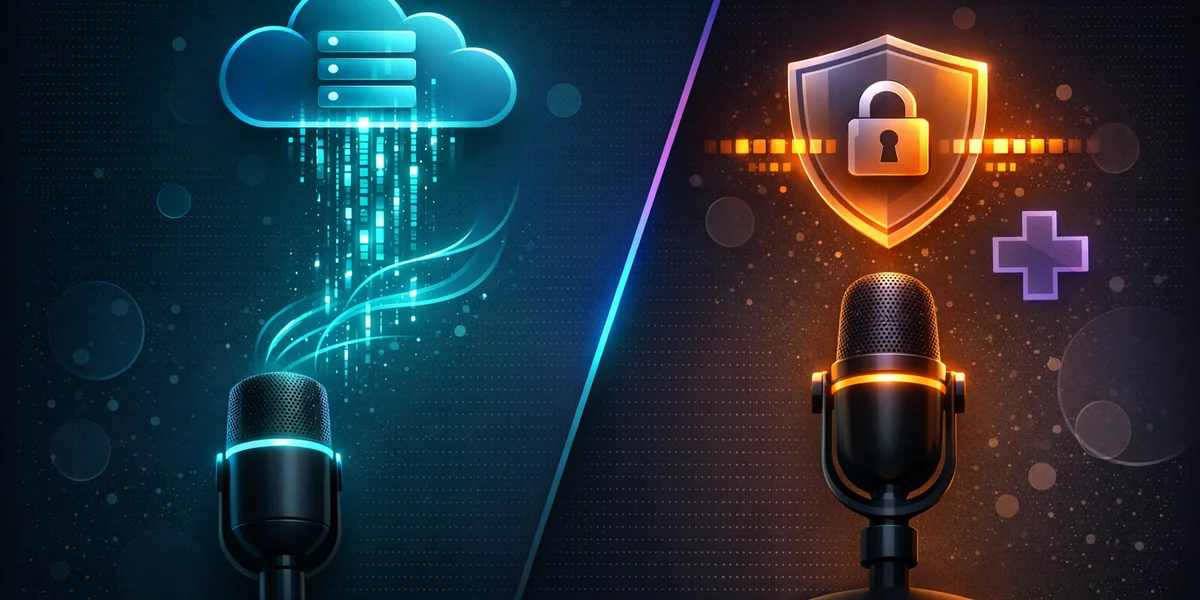
An ambient AI scribe is a system that listens to the entire patient encounter — questions, answers, side comments, family discussions — and uses a large language model to generate a structured clinical note. The microphone is typically always on during the visit, with audio streamed to a vendor’s cloud for transcription and summarisation.
That architecture creates three layered risks:
- Consent risk — In two-party-consent states, every participant in a conversation must agree to the recording before it begins.
- Data-transmission risk — Protected health information leaves the clinical setting in real time, expanding the breach surface.
- AI-fabrication risk — Large language models fill gaps with plausible-sounding content, which can produce notes that misstate what was actually said.
A recent class action against Sharp HealthCare alleges that patient charts auto-populated with phrases indicating consent had been obtained when, according to the recordings themselves, no such consent was given. That single allegation captures all three risks at once.
Are Ambient AI Scribes HIPAA-Compliant in 2026?
In a narrow technical sense, an ambient AI scribe can be HIPAA-compliant — provided the vendor signs a business associate agreement, encrypts data at rest and in transit, and limits access appropriately.
In a practical legal sense, HIPAA compliance does not equal lawful recording. According to Alston & Bird’s privacy team, general privacy notices, implied consent or ad hoc clinician disclosures may not be enough in California, an all-party-consent jurisdiction. Illinois, Washington, Florida, Pennsylvania, Massachusetts, Maryland, Connecticut, Montana, New Hampshire, Nevada (under recent interpretations) and Oregon impose similar two-party rules with varying nuances.
The gap is meaningful. A practice can have an ironclad HIPAA programme — and still face statutory damages, criminal exposure or class-action liability if ambient recording began before every participant explicitly agreed.
Active Dictation vs Ambient AI Scribes: Side-by-Side
The choice between active and ambient dictation is not about which is “newer” — it is about which risks each model creates, and which a given practice is willing to accept.
| Criterion | Ambient AI Scribe | Active Dictation |
|---|---|---|
| Audio captured | Full patient encounter | Clinician’s voice only |
| Patient consent required | All-party consent in 11+ US states | Not required (no patient recording) |
| Long-term audio storage | Yes, often in vendor cloud | None (with offline tools) |
| Data transmitted off-site | Yes — to vendor servers | Optional; zero with offline tools |
| AI hallucination risk | High (note generated from inference) | Low (text reflects exact words) |
| State wiretapping exposure | High in 2-party states | None |
| EHR time saved per 8 patient-hours (JAMA 2026) | 13.4 minutes | Comparable with modern dictation tools |
| Setup cost | $200–$500/user/month enterprise | €5/month (Weesper Neon Flow) |
| Best for | Structured primary-care visits with explicit written consent | High-stakes notes, sensitive disclosures, regulated jurisdictions |
The picture is not “ambient AI is bad”. It is that ambient AI carries a stack of risks that active dictation simply does not generate. For many specialists, the maths no longer favours ambient.
What the 2026 JAMA Study Actually Found
In April 2026, a JAMA study covering 8,581 clinicians at five US academic health systems produced the most rigorous independent assessment of ambient AI scribe adoption to date.
The headline numbers were sobering for vendors:
- 13.4 fewer minutes of electronic health record time per 8 scheduled patient hours.
- 16.0 fewer minutes of documentation time over the same period.
- No significant reduction in after-hours charting.
- 1,809 adopters out of 8,581 clinicians — at four of the five sites, adoption was left to eligible physicians opting in.
The study does not record why most clinicians never became adopters. What it does measure is the gap between the pitch and the effect: a few minutes returned inside the working day, and no change at all to the charting that spills outside it.
Why Privacy-Conscious Doctors Are Choosing Active Dictation
Active dictation has three properties that ambient AI scribes structurally cannot match.
Total control over what is recorded. The clinician chooses when to start, what to say and when to stop. A patient’s emotional disclosure, a partner’s side comment, an off-topic remark — none of it enters the record unless the clinician decides it should.
Zero ambient data outside the encounter. With a fully offline tool, no audio leaves the device. There is no vendor cloud, no third-party transcription pipeline and no long-term audio retention to subpoena, breach or misuse. This is a structural privacy guarantee, not a policy promise.
A defensible audit trail. Active dictation produces text that mirrors the clinician’s exact words. If a malpractice question later arises about whether a particular phrase appeared in the note, the answer is straightforward — the clinician said it, deliberately. Ambient AI introduces a layer of LLM interpretation between what was said and what was written.
For clinicians worried about ambient AI scribe privacy risks, a tool like Weesper Neon Flow delivers active dictation with 100% local processing — no cloud, no recording of patients, no consent paperwork to manage. You can try Weesper free on macOS or Windows.
What About the Time-Saving Argument?
The 13.4 minutes of electronic health record time saved per 8 scheduled patient hours in the JAMA study is real but modest, and it does not account for the time spent reviewing AI-generated notes for errors, handling patient questions about recording, training staff on consent scripts, or auditing vendor data-handling.
Modern active dictation tools have closed much of the historical gap. With local whisper.cpp models and Metal acceleration on Mac, transcription happens in near real-time at accuracy levels that rival enterprise cloud services. For a clinician who has refined their dictation workflow, the difference is often a matter of minutes — not hours.
Practical workflow comparison:
- Ambient AI: encounter → recording continues → AI summarisation → clinician review and correction → finalisation. Estimated total clinician time per note: 4–7 minutes.
- Active dictation: encounter → 30–90 seconds of structured speech → minor edits → finalisation. Estimated total clinician time per note: 3–5 minutes.
These ranges depend heavily on speciality, note complexity and dictation experience. For high-volume primary care, ambient AI can edge ahead; for surgical, radiological or psychiatric notes, active dictation often wins on both speed and accuracy.
Practical Steps for Doctors Reassessing Their Workflow
If you are considering whether ambient AI is the right fit for your practice in 2026, work through these questions in order.
- Map your state’s recording laws. Two-party-consent states require active patient agreement before any recording begins. Confirm which statutes apply where your patients are physically located.
- Review your vendor contracts. Ensure your business associate agreement explicitly addresses audio storage, deletion timelines, vendor sublicensing and the right to audit.
- Audit your consent process. If consent is auto-populated in your EHR template, that is a litigation flag — patients must hear and agree to the recording in real time.
- Pilot active dictation on high-risk notes. For your Assessment & Plan sections, sensitive disclosures, and any speciality where word-for-word accuracy matters, run a four-week trial with an offline tool.
- Measure both time and risk. Track minutes saved, but also track patient questions about recording, AI correction time, and any compliance flags from your privacy officer.
For practical implementation guidance, see our HIPAA-compliant voice dictation guide for medical professionals and our broader analysis of active dictation versus ambient AI listening for professionals. Weighing a medical-only tool against a general-purpose one? Our hands-on Dictadoc review covers pricing, offline architecture and where it falls short for non-clinical dictation.
Where the Market Goes From Here
The composition of the market is shifting. Vendors that built their pitch on ambient AI alone are quietly adding active-dictation modes. Health systems that signed multi-year ambient contracts in 2024 are now writing clauses allowing them to disable ambient features pending consent-process audits.
The lesson from the lawsuits and the JAMA data is the same. Voice technology is not the problem. Lack of clinician control over what gets recorded is the problem. Active dictation solves it by design.
Conclusion: Dictate When You Choose, Not When the AI Decides
Ambient AI scribes are not disappearing — they will keep their place in low-stakes, high-volume workflows where patients have given clear, conversation-specific consent. But for clinicians who handle privileged disclosures, mental health content, sensitive specialties or patients in two-party-consent states, the legal and ethical maths of 2026 favours active dictation.
The principle is simple: dictate when YOU choose, not when the AI decides. With a 100% offline tool like Weesper Neon Flow, you keep audio on your device, you keep patients out of the recording, and you keep the audit trail in your own hands.
Ready to take back control of your documentation workflow? Download Weesper Neon Flow for macOS or Windows and start a free trial — no credit card, no cloud account, no consent forms to manage. For setup and best practices tailored to clinical use, see our Help Centre and our guide to offline voice dictation for privacy.