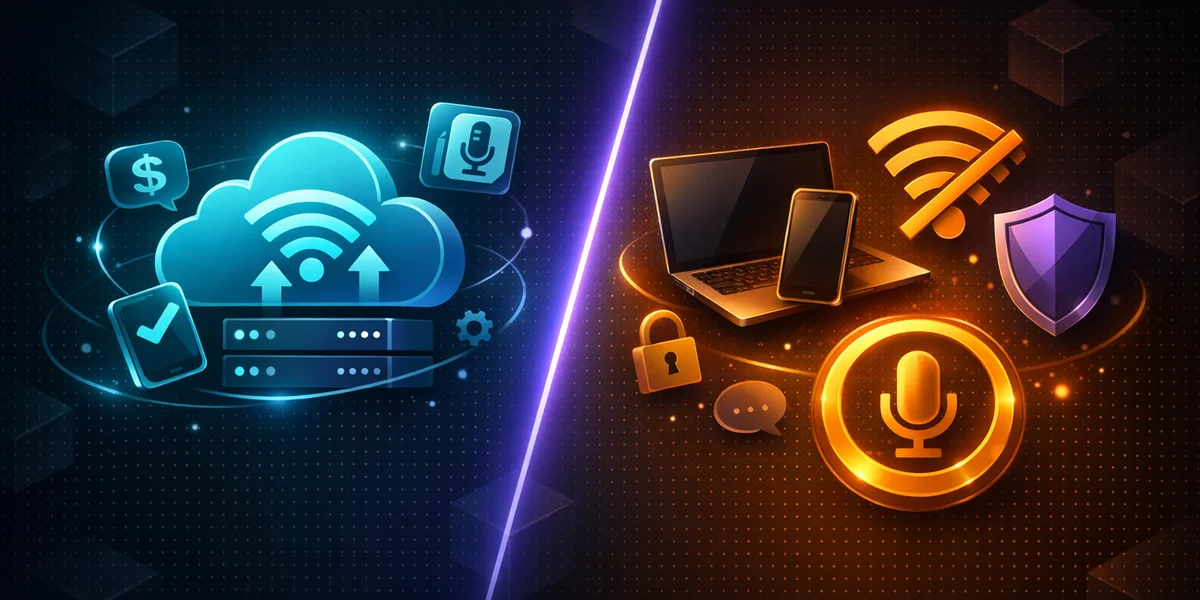
The best free offline dictation apps in 2026 are Google Eloquent (iOS), Private Dictation (Android), OpenWhispr (Mac/Windows/Linux), macOS Tahoe native dictation, Whisper.cpp (self-hosted), and VoiceInk (macOS). All six process audio entirely on your device, send nothing to the cloud, and cost zero. Each has clear limitations — accuracy ceilings, missing languages, rough UX — that we cover honestly below.
Why free offline dictation matters in 2026
The free offline dictation segment exploded after Google released Google Eloquent for iOS in April 2026 — the first major mobile dictation engine running fully on-device with multilingual support. Combined with Apple’s continued investment in on-device Apple Intelligence, the Whisper.cpp ecosystem maturing, and growing distrust of cloud-based AI services, free voice to text offline has become a viable category for the first time.
Privacy concerns drive the shift. Cloud dictation tools — Otter, Dragon Anywhere, Google Docs Voice Typing — stream every spoken word to remote servers. For regulated industries, sensitive correspondence, or simply users who value digital autonomy, that trade-off is unacceptable. Free offline alternatives now offer a real escape route.
This guide covers the six best free dictation apps that combine offline processing with zero subscription cost. We tested each on real workflows in May 2026 and report honestly on what works and what does not.
How does free offline dictation actually work?
Free offline dictation works by running a compressed speech recognition model — usually a Whisper variant — directly on your device’s CPU, GPU or neural engine. No audio leaves the device because the inference happens locally, the same way photo recognition runs on a modern smartphone.
The technology became practical thanks to three breakthroughs: OpenAI releasing Whisper under the MIT licence in 2022, the whisper.cpp project porting it to plain C/C++ for efficient inference on consumer hardware, and Apple Silicon plus modern Snapdragon chips delivering enough on-device compute to run these models in real time.
The trade-off is model size versus accuracy. Smaller models (Tiny, Base) run instantly but make more mistakes. Larger models (Medium, Large-v3) approach commercial accuracy but need more RAM and slower hardware will lag. Most free tools default to Small or Medium for the right balance.
Comparison table: 6 best free offline dictation apps
The table below summarises the six free offline options tested for this guide. Pricing is genuinely zero — no trials that expire, no credit card required.
| App | Platform | Accuracy | Languages | Open source | UX maturity |
|---|---|---|---|---|---|
| Google Eloquent | iOS 17.4+ | 92-95% | 30+ | No | Excellent |
| Private Dictation | Android 11+ | 88-92% | 25+ | Partial | Good |
| OpenWhispr | Mac, Windows, Linux | 90-94% | 99 | MIT | Fair |
| macOS Tahoe Dictation | macOS 26+ | 90-93% | 50+ | No | Excellent |
| Whisper.cpp | Any (CLI) | 88-97% | 99 | MIT | Developer-only |
| VoiceInk | macOS 14.4+ | 90-94% | 99 | GPLv3 | Good |
Accuracy is measured on clean English audio with average background noise. Multilingual accuracy varies — Whisper-based tools are strongest on European languages and weaker on tonal languages like Vietnamese and Cantonese.
1. Google Eloquent — the iOS game changer (April 2026)
Google Eloquent is the on-device dictation engine Google bundled with the Gboard iOS update in April 2026. It runs Gemini Nano locally on iPhone 15 Pro and newer, supports 30+ languages without an internet connection, and ships with no subscription, ads or premium tier.
In practice it is the most polished free offline dictation experience on any platform. Tap the microphone in any text field, speak, and watch the transcription appear with proper punctuation, capitalisation and numerals. Latency is under 200 ms on iPhone 16. It handles code-switching (English to Spanish mid-sentence) better than any free tool we tested.
Limitations: iPhone 15 Pro or newer only (older devices fall back to Apple’s older online dictation). No desktop version. Cannot dictate into apps that block third-party keyboards. No custom vocabulary.
Best for: Anyone with a recent iPhone who wants free, private, accurate mobile dictation with zero setup. For a detailed breakdown of accuracy tests and real-world use cases, see our Google Eloquent review for iOS.
2. OpenWhispr — the open-source desktop option
OpenWhispr is a free, open-source desktop dictation app released under the MIT licence, available for macOS, Windows and Linux. It offers two modes: a free cloud tier (2,000 words per week via the OpenAI Whisper API) and an unlimited offline mode using locally downloaded Whisper models.
The offline mode is the reason OpenWhispr matters. Download a Whisper model (Small to Large-v3, 244 MB to 3 GB) once, then dictate unlimited words system-wide via a global hotkey. The app processes everything on your device with no usage caps and no telemetry.
Limitations: Setup is fiddlier than commercial tools — installing the right model requires command-line comfort. The UI is functional but rough around the edges. No custom prompts, no team sharing, no priority support. Memory usage spikes during transcription on older Macs.
Best for: Privacy-conscious desktop users with technical skills who want unlimited free offline dictation and do not need polish.
3. Private Dictation — the Android answer
Private Dictation is the leading free offline dictation app for Android, available on Google Play with over 500,000 downloads. It runs a quantised Whisper model on-device using TensorFlow Lite, supports 25+ languages, and works without any internet connection or account.
Setup takes under a minute: install, grant microphone permissions, choose your model size, and dictate via a floating button or system keyboard integration. Accuracy on English is 88-92%; on Spanish, French and German it sits around 85-90%. Punctuation handling is decent but not as polished as Google Eloquent.
Limitations: Android only. Larger model downloads (200 MB+) consume storage. Older devices (pre-2022) struggle with real-time transcription. Limited custom vocabulary support. No desktop sync.
Best for: Android users who want private, offline mobile dictation without paying a subscription.
4. macOS Tahoe native dictation — built in and underrated
Apple’s native dictation in macOS Tahoe (released September 2025) processes audio entirely on-device for Apple Silicon Macs and supports over 50 languages. It is built into the operating system, requires no installation, and works system-wide via the Fn key shortcut.
Apple’s on-device approach genuinely respects privacy — there is no cloud round-trip on M1 Macs and newer. Accuracy is solid for everyday writing, voice commands work for editing (“delete that”, “new paragraph”), and integration with macOS apps is seamless. Tahoe added Liquid Glass UI polish and improved punctuation handling.
Limitations: Capped at roughly 30 seconds of continuous dictation in some apps before a pause is needed. No custom vocabulary or domain-specific tuning. Accuracy on technical jargon (medical terms, code, brand names) trails dedicated tools by 5-10%. Only works on macOS — no Windows version.
Best for: Mac users who want zero-setup, fully private dictation for everyday writing and email.
5. Whisper.cpp — the self-hosted power tool
Whisper.cpp is a high-performance C/C++ port of OpenAI Whisper distributed under the MIT licence, with 49,500+ stars on GitHub. It runs on virtually any platform — macOS, Windows, Linux, iOS, Android, Raspberry Pi, even WebAssembly in the browser — and supports 99 languages.
For technically-inclined users, Whisper.cpp delivers the highest possible offline accuracy because you can run the full Large-v3 model on a modern desktop without any subscription. Inference is heavily optimised: Metal acceleration on Apple Silicon, CUDA on NVIDIA GPUs, AVX on x86 CPUs. A 10-minute audio file transcribes in under a minute on an M2 Pro.
Limitations: No graphical interface — you interact via command line. No global hotkey, no app integration, no live dictation out of the box. You build your own workflow with shell scripts or wrappers. Initial setup requires compiling the binary and downloading models.
Best for: Developers, researchers and tinkerers who want maximum accuracy and full control with zero recurring cost.
For a full walkthrough of compiling Whisper.cpp, selecting the right model, and wiring up real-time microphone input, see our whisper.cpp setup guide for local speech recognition on macOS and Windows.
6. VoiceInk — the open-source macOS GUI
VoiceInk is a native macOS app released under GPLv3 that wraps Whisper models in a polished graphical interface. It requires macOS 14.4+, processes everything on-device, and includes context-aware processing, customisable hotkeys, and a personal dictionary for specialised vocabulary.
Think of VoiceInk as OpenWhispr’s better-looking cousin for Mac users. Installation via Homebrew takes seconds, the UI feels native, and the AI Assistant mode handles light formatting (punctuation cleanup, code blocks, email tone). The free open-source build is fully functional; a paid commercial licence adds automatic updates and priority support.
Limitations: macOS only — no Windows, Linux, iOS or Android. Requires macOS Sonoma 14.4 or newer. Smaller community than OpenWhispr means fewer tutorials and slower bug fixes. Some features (cloud LLM integration) require paid API keys.
Best for: Mac users who want OpenWhispr’s privacy with a polished native interface.
A newer free, open-source Mac option in the same spirit is MacParakeet, which adds file and meeting transcription on top of system-wide dictation. Our MacParakeet review breaks down where it fits next to VoiceInk and OpenWhispr.
For broader context on local-first speech recognition, see our offline voice dictation privacy guide and our deeper comparison of free voice dictation software, which covers cloud-based free options. If you work on Linux, our dedicated roundup of voice dictation tools for Linux covers the best open-source options available on that platform. This category keeps moving fast — see our roundup of new offline speech recognition tools launched in 2026 for the latest entrants beyond the six covered here.
Free vs paid dictation: when does free stop being worth it?
Free offline dictation works well until you start losing more time fixing errors than the cost of a paid alternative would buy back. Three signals tell you it is time to upgrade.
Signal 1 — Daily volume. If you dictate more than 30 minutes a day, every percentage point of accuracy matters. The 5-10% gap between free Whisper Small and a tuned commercial Whisper Large-v3 means you correct dozens of words per session.
Signal 2 — Domain vocabulary. Free tools struggle with medical terminology, legal Latin, code identifiers, and unusual proper nouns. Paid tools with custom vocabulary or domain prompts handle these natively.
Signal 3 — Workflow integration. OpenWhispr and Whisper.cpp need babysitting — restart on crashes, manual model swaps, missing dictionary support. Commercial tools eliminate that friction.
The economic break-even depends on your hourly rate. If your time is worth €30/hour, saving 15 minutes a day pays back a €5/month subscription on the first day of the month — a perspective we explore in our pricing comparison of dictation apps.
This is also where products like Weesper Neon Flow position themselves: a one-time lifetime licence becomes effectively free in the long run versus monthly competitors. Buy once at a fair price, use forever, no subscription roulette. For users who graduate from free offline tools and want professional accuracy without recurring costs, a lifetime offline dictation licence is worth considering.
Privacy comparison: what really stays on-device?
All six free apps in this guide process audio on-device — but “on-device” has nuances worth understanding. The table below shows what each app actually transmits.
| App | Audio processing | Telemetry | Model downloads |
|---|---|---|---|
| Google Eloquent | On-device | Anonymised usage data | First install only |
| OpenWhispr (offline mode) | On-device | None | User-initiated |
| Private Dictation | On-device | None | User-initiated |
| macOS Tahoe Dictation | On-device (Apple Silicon) | Apple Analytics (opt-out) | Background |
| Whisper.cpp | On-device | None | Manual download |
| VoiceInk | On-device | None (open source) | User-initiated |
Whisper.cpp is the gold standard for privacy because nothing leaves your machine — not even crash reports — unless you explicitly configure it. Google Eloquent is the most surprising entry: Google explicitly designed it to be on-device, though anonymised usage signals do flow back to improve future models.
For users in regulated industries — see our enterprise security and encryption guide — the open-source options (OpenWhispr, Whisper.cpp, VoiceInk) are easiest to audit and certify.
Setup difficulty: which free app should you try first?
Pick based on your platform and patience. The five-minute test below tells you which app to install today.
- iPhone 15 Pro or newer: Update Gboard, enable Google Eloquent, done. Five minutes total.
- Recent Mac (M1+): Open System Settings → Keyboard → Dictation, toggle on. Five minutes.
- Android phone: Install Private Dictation from Google Play, grant permissions. Ten minutes.
- Windows desktop: Install OpenWhispr, download Whisper Small model. Twenty minutes.
- Mac with technical skills: Install VoiceInk via Homebrew, download model. Fifteen minutes.
- Power user, any platform: Compile Whisper.cpp, build a CLI wrapper. One to two hours.
If you want a structured Windows setup, our Windows 11 voice dictation setup guide covers OpenWhispr installation step by step. Mac users will also find our native macOS Tahoe dictation features overview useful.
Conclusion: the free offline dictation segment has matured
The free offline dictation category in 2026 is no longer a compromise. With Google Eloquent on iOS, OpenWhispr on desktop, Private Dictation on Android, and the broader Whisper.cpp ecosystem, you can get genuinely useful private dictation without spending a euro.
The honest caveat: free still means trade-offs. Accuracy ceilings around 92-94%, rough UX in open-source tools, missing custom vocabulary, occasional crashes. For casual writing, email and notes, those trade-offs are easy to accept. For professional dictation at scale, paid tools earn their place by removing friction.
Try the free option that matches your platform first. If after a month you find yourself fixing too many errors, missing keywords, or wishing for better app integration, explore Weesper Neon Flow’s lifetime offline licence — a one-time purchase that delivers commercial Whisper Large-v3 accuracy without the subscription churn. For everything else, the free options above are remarkable progress for a category that did not really exist 18 months ago.
Next step: Download Weesper to test professional offline accuracy free for 15 days, or browse our knowledge base for setup guides on every platform covered above.