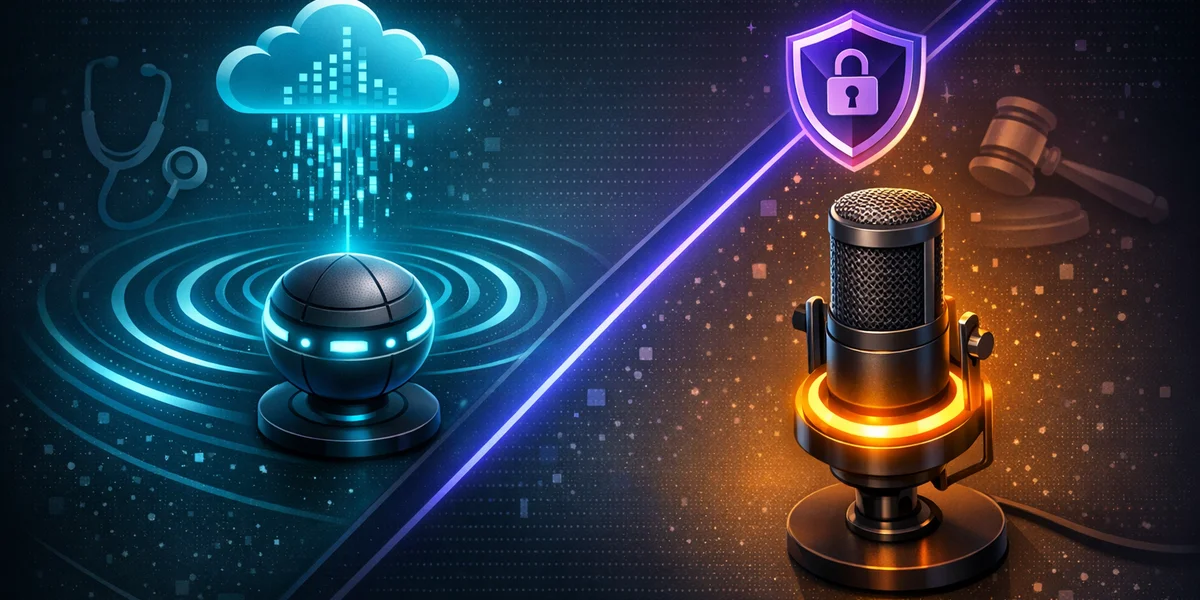
Active dictation means deliberately speaking your documentation — pressing a button, recording your exact words, releasing. Ambient AI listening records your entire environment continuously and uses AI to summarise what happened. In 2026, a growing number of healthcare professionals, lawyers, and therapists are choosing the former, despite ambient AI’s marketing dominance. The reason is not nostalgia — it is control, liability, and privacy.
What Is Ambient AI Listening, and Why Did It Become Popular?
Ambient AI listening captures everything said in a room — patient encounter, phone call, consultation — and uses a large language model to generate structured clinical or legal notes automatically.
The appeal is obvious. Clinicians spend an estimated two hours on documentation for every one hour with patients. Tools like Nuance DAX and similar ambient scribes promised to reclaim that time with no change in workflow.
For primary care, where encounters are conversational and stakes are relatively routine, this largely worked. A 2026 survey found 79% of healthcare organisations now use some form of ambient speech technology for clinical documentation.
But that adoption figure obscures a quieter counter-movement happening in specialised and high-stakes fields.
Why High-Stakes Professionals Are Pulling Back from Ambient AI
The problem is not accuracy in the aggregate — it is accuracy when it matters most.
Ambient AI scribes report overall error rates of approximately 1–3%. That sounds reassuring until you realise that in clinical documentation, a single misattributed statement can constitute a falsified record.
A Reuters investigation cited malpractice cases where ambient scribes documented that a patient “verbalized understanding and consent” — when the recording showed the doctor rushed the explanation and the patient said nothing. The AI inferred consent from conversational context. The physician signed off without catching the nuance. The liability transferred immediately.
As researcher Ryan Shrott argued in a widely-cited February 2026 analysis: “Active dictation is what you said. Ambient summary is what the AI thought you meant.”
This distinction is not philosophical. It is the difference between a defensible record and an AI-generated inference with your signature on it.
Active Dictation vs Ambient AI: Feature Comparison
| Feature | Active Dictation | Ambient AI Listening |
|---|---|---|
| What is recorded | Only what you deliberately speak | Entire room audio, continuously |
| Patient conversation recorded | No | Yes |
| Documentation accuracy | Word-for-word | AI interpretation (1–3% error rate) |
| Liability exposure | Low — direct transcription | Higher — AI inference + clinician sign-off |
| Privacy risk | Minimal — local or brief cloud pass | High — full encounter stored in cloud |
| Offline operation possible | Yes (with tools like Weesper) | Rarely — requires cloud LLM |
| Correction required | Minimal — real-time control | Frequent — post-encounter review |
| Consent requirements | None for dictation phase | Complex — varies by jurisdiction |
| Best for | Specialists, legal, therapy | Routine primary care |
| Data sovereignty | Full | Dependent on vendor policy |
The Liability Maths for Clinicians and Lawyers
In healthcare, radiology offers the clearest case study. A radiologist who dictates “comminuted fracture of the mid-shaft left femur with 2cm displacement” has a direct, verifiable record. An ambient system must infer this from a conversation that may have included clarification questions, pauses, corrections, and informal speech.
LLMs, by design, fill gaps with plausible content. In creative writing, this is a feature. In clinical documentation, it is a liability.
The npj Digital Medicine study (2025) identified four distinct failure modes in ambient AI scribes: hallucinations, critical omissions, misattribution (statements assigned to the wrong speaker), and contextual misinterpretation. Critically, these errors cluster in technically dense content — precisely the content specialists generate.
For lawyers, the risk is different but equally acute. Ambient listening records privileged client conversations in their entirety. Even with vendor agreements about data handling, those recordings exist. They can be subject to breach, subpoena, or regulatory scrutiny. Active dictation records only the lawyer’s summary — not the conversation — keeping privileged material where it belongs: in the professional’s mind, not on a server.
The Privacy Architecture That Makes Active Dictation Safer
Ambient AI has a structural privacy problem: it must capture everything to summarise anything.
Even systems that claim to process audio locally still need to record the full encounter to perform LLM summarisation. The moment a patient conversation is converted to a transcript — even temporarily — it becomes governed data.
Active dictation bypasses this entirely. The clinician, lawyer, or therapist speaks their note during a pause, after the patient has left, or between calls. No patient conversation is recorded. No sensitive disclosure is transcribed. The documentation surface is precisely the professional’s own words.
Weesper Neon Flow takes this further: all processing runs locally on your Mac or Windows machine via whisper.cpp. No audio reaches the internet — not even for a millisecond. The hold-to-speak model is active dictation at the hardware level. You control exactly when the microphone opens and closes.
This is a meaningful distinction when therapists handle trauma disclosures, lawyers manage privilege, or physicians document psychiatric assessments.
When Ambient AI Still Makes Sense
The counter-narrative should not erase ambient AI’s genuine strengths. For routine primary care, where documentation volume is high and note structure is relatively standardised, ambient AI offers real time savings with acceptable risk.
The 2026 best practice emerging in forward-thinking clinical environments is a deliberate split: use ambient AI for the Subjective section of a SOAP note (patient-reported symptoms in conversational language), and switch to active dictation for Assessment & Plan — the section with the highest liability exposure and the highest technical precision requirement.
This hybrid approach limits ambient AI to territory where its weaknesses matter least, while preserving active dictation for the content that counts.
For lawyers, the equivalent split is using ambient AI to capture meeting summaries in low-stakes internal discussions, while dictating active notes for case strategy, privileged advice, and client representations.
The Disclosure Pressure Is Only Increasing
A second trend is reinforcing the return to active dictation: AI disclosure requirements.
Several US states and the EU AI Act now require professionals to disclose when AI has played a material role in generating patient-facing or client-facing documentation. The more AI contributed, the more disclosure is required. Signing off on an ambient AI summary — even after reviewing it — increasingly carries disclosure obligations.
Active dictation sidesteps this. The note represents your words, transcribed. AI converted speech to text, a process no different in legal substance from a typist transcribing a recording. The professional’s voice and clinical judgement are the source of record.
For legal professionals navigating bar ethics rules on AI disclosure, this distinction is rapidly becoming a practical differentiator. For therapists under HIPAA and state mental health recording laws, it simplifies consent management entirely.
How Weesper’s Hold-to-Speak Model Fits This Landscape
Weesper’s hold-to-speak software was built around active dictation from day one. The hold-to-speak model — hold a hotkey, dictate, release — is not a feature; it is the product architecture.
Every transcription runs on-device via Metal-accelerated whisper.cpp on Mac, with CPU optimisation on Windows. Nothing is sent to the cloud. There are no background microphone activations, no passive listening sessions, no conversation capture.
For a physician documenting a psychiatric assessment, a lawyer drafting privileged notes, or a therapist summarising a session, this means:
- The microphone opens only when you choose
- Patient and client voices are never recorded
- The resulting text is exactly what you said
- The file never leaves your device unless you copy it somewhere
This is what active dictation looks like when privacy is treated as an architectural requirement rather than a marketing claim.
Read more in our complete guide to HIPAA-compliant voice dictation and our analysis of offline voice dictation and GDPR compliance.
Conclusion: Control Is the Feature
In 2026, ambient AI listening is a mature technology with a clear niche. For high-volume, routine documentation in primary care, it delivers measurable time savings.
But for professionals where precision is non-negotiable, where liability attaches to every word, and where patient or client privacy is a legal and ethical obligation — active dictation is not a retreat from AI. It is the intelligent deployment of it.
The professionals returning to active dictation are not rejecting technology. They are refusing to outsource their clinical judgement to a probabilistic inference engine.
Try Weesper Neon Flow free for 15 days — active dictation, fully offline, built for professionals who cannot afford to leave their words to interpretation.
Visit our Help Centre for setup guides, hotkey configuration, and workflow tips for healthcare, legal, and therapeutic use.